
















 It’s Only Common Sense: When the Cheapest Board Becomes the Most Expensive
 The Chemical Connection: Employee and Operator Empowerment in the Age of AI
 The Big Picture: Not One, But Three Grey Rhinos





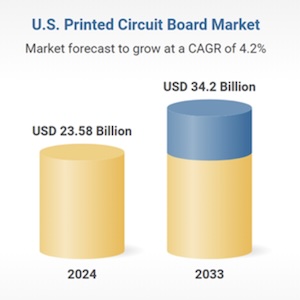
The United States printed circuit board market is expected to reach $34.2 billion by 2033 from $23.58 billion in 2024, with a CAGR of 4.22% from 2025 to 2033.
Growing demand for electronics, the expansion of the automotive and aerospace industries, improvements in flexible and high-density PCB technology, the growing use of wearable and Internet of Things devices, and investments in 5G, artificial intelligence, and renewable energy technologies are the main factors propelling the U.S. PCB market.
The increased need for consumer electronics, such as wearables, laptops, and smartphones, which call for intricate, high-density boards, is driving growth in the U.S. PCB industry. The demand for sophisticated PCBs for sensors, battery management, and entertainment systems is driven by the expansion of the automotive industry, especially in electric and driverless vehicles.
Miniaturization and improved performance are made possible by technological developments in flexible, multilayer, and high-frequency PCBs. The need for dependable and fast circuit boards is growing as 5G networks and AI applications expand. The aerospace, defense, and renewable energy industries are also making significant investments in electronic systems, which is helping to fuel the expansion of the PCB industry in the United States.
Growth Drivers for the United States Printed Circuit Board Market
Rising Electronics Demand
One of the main factors propelling the US PCB market is the rising demand for consumer and business electronics. Printed circuit boards are essential to the operation of smart home systems, game consoles, wearable technology, laptops, tablets, and smartphones. High-density and multilayer PCBs are becoming more and more necessary for manufacturers to include more features into small devices without sacrificing performance as a result of shrinking trends.
The demand for PCBs is further increased by the proliferation of smart devices and Internet of Things applications in residential, commercial, and industrial environments. Complex PCBs are also used in healthcare electronics, such as monitoring and diagnostic devices, to provide dependable performance. The U.S. PCB market continues to expand because to ongoing technological advancements and rising consumer demands for gadgets that are quicker, smarter, and use less energy. In order to meet the demands of next-generation electronic devices, manufacturers are also experimenting with new materials and designs that enhance durability, signal integrity, and thermal management.
Automotive Sector Growth
The demand for PCBs in the US is being driven mostly by the automobile sector. Electronics play a major role in battery management systems, sensors, infotainment, advanced driver-assistance systems (ADAS), and networking in modern automobiles, especially electric vehicles (EVs) and autonomous vehicles. For these electronic components to be integrated effectively and dependably, PCBs are necessary.
The complexity and quantity of PCBs needed per car rise sharply as vehicle electrification picks up speed. PCB requirements are further increased by the growing number of smart and connected cars, which depend on telematics and in-car communication systems. Because the automobile industry prioritizes performance, safety, and efficiency, high-quality, multilayer, high-frequency PCBs are required. The U.S. PCB market benefits from ongoing demand in design, production, and innovation to support next-generation automotive electronics, which is fueled by increasing investments from both traditional automakers and EV startups.
5G and AI Adoption
The introduction of 5G networks and the growing use of AI technologies are two of the main factors propelling the PCB market in the United States. Antennas, base stations, and other 5G infrastructure require multilayer, high-speed, high-frequency PCBs that can handle massive data volumes with little signal loss. like order to handle processing power, connection, and heat, AI applications like data centers, robots, autonomous vehicles, and smart devices also require sophisticated PCBs.
PCBs now need to be more precise, complicated, and reliable because to these technologies. The need for circuit boards with high-performance operation is further increased by the quick growth of cloud computing, edge devices, and IoT ecosystems. The U.S. PCB market continues to develop in size and technological sophistication as AI and 5G usage spreads throughout sectors like consumer electronics, healthcare, telecommunications, and the automobile industry.
Challenges in the United States Printed Circuit Board Market
Supply Chain Disruptions
The printed circuit board (PCB) industry in the United States is heavily reliant on imported raw materials, including copper, fiberglass, laminates, and specialty chemicals. Global supply chain disruptions brought on by trade restrictions, natural disasters, or geopolitical unrest can raise operating costs, delay the delivery of materials, and interfere with production plans.
The capacity of manufacturers to achieve production deadlines for electronics, such as industrial equipment, automotive systems, and consumer products, is impacted by these disruptions. Furthermore, the market is susceptible to unexpected shortages, price volatility, and inconsistent quality due to its reliance on a small number of suppliers. Maintaining constant PCB output and competitiveness requires establishing alternate sourcing methods and ensuring supply chain resilience, both of which are difficult tasks.
Intense Competition
Both domestic and foreign competitors pose a serious threat to the U.S. PCB business. To satisfy the increasing demands of sophisticated electronics, manufacturers must continuously develop in high-density, multilayer, flexible, and high-frequency PCBs. Pricing and profit margins are under pressure from international rivals, who frequently have cheaper production costs.
U.S. PCB manufacturers must make significant investments in R&D, production technology, and quality control to stay competitive, which raises operating expenses. Smaller businesses could find it difficult to compete with major manufacturers who have established client networks, advanced manufacturing skills, and economies of scale. Therefore, in a highly competitive sector, maintaining cost effectiveness and technological superiority is a constant problem.


