












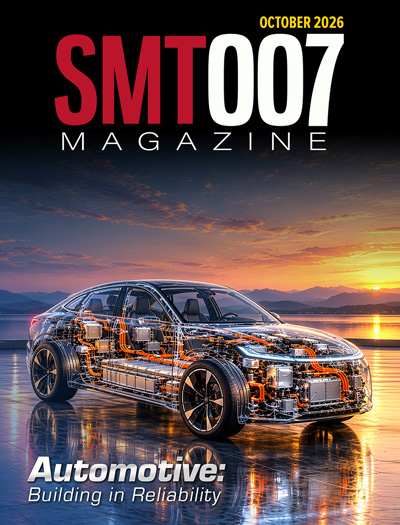



 Nolan’s Notes: Automotive Is Gearing Up Again
 Standard of Excellence: Engineering Collaboration Has Become the New Sales Strategy
 Bridging the Pacific: Why Global Manufacturing Is No Longer Optional





As one of the leading providers of high-performance thermal materials solutions, Indium Corporation® is proud to feature its lineup of metal thermal interface materials and other high-reliability products at The International Conference for High Performance Computing, Networking, Storage, and Analysis (SC25), taking place November 16-21, in St. Louis, Missouri.
The company will showcase the following among its featured products:
- Solder Thermal Interface Materials (sTIMs) deliver superior heat dissipation and high thermal conductance for power-dense devices exceeding 1,000 watts. Optimized for BGA package applications, they enable low-void, high-reliability performance across multiple reflow cycles, ensuring thermal stability. Unlike fluidic solutions, they ensure reliable end-of-life performance, preventing failures common with greases. Ideal for portable electronics, they enhance battery life, reduce cooling fan size, and minimize heat-sink mass while maintaining RoHS compliance and supporting steps.
- Heat-Spring® is a compressible, non-reflow metal TIM ideal for TIM2 applications. These indium-containing TIMs offer superior thermal conductivity over non-metals, with pure indium metal delivering 86W/mK in all planes. Because of its solid metal state, Heat-Spring® avoids pump-out and bake-out problems. It also offers a sustainable solution due to the company’s indium Reclaim and Recycle program.
- Liquid Metal TIMs are designed to provide superior thermal conductivity for both TIM0 and TIM1 applications. Liquid Metal TIMs offer high thermal conductivity to enhance end-product longevity and reliability, low interfacial resistance against most surfaces to dissipate heat quickly, and extraordinary wetting ability to both metallic and nonmetallic surfaces. They are available in a variety of alloys, including InGa and InGaSn.
- Phase-Change Metal Alloy (PCMA) TIMs are low-melting alloys solid at room temperature, with a melting point as low as 30°C. They provide exceptional thermal conductivity and reliability for TIM1.5 applications. They offer thermal performance similar to liquid metal, but allow for better volume control and can be used in high-volume production. PCMA TIMs are available in Ga-based and Ga-free options.
- Durafuse® HR, a trusted and proven solder paste alloy technology, delivers enhanced thermal cycling capabilities (-40°C/125°C and -40°C/150°C) and superior voiding control for high-reliability automotive applications. It also offers reduced solder joint cracking and increased shear strength.
- Durafuse® LT is a solder paste alloy system engineered to decrease peak reflow temperature without compromising performance. It can reduce energy usage, improve reliability, and enable step soldering. It is ideal for assemblies with large temperature gradients and components prone to complex warpage during reflow. Durafuse® LT delivers superior thermal cycling and drop shock performance, outperforming conventional low-temperature solders like BiSn or BiSnAg alloys, and can outperform SAC305 under optimal process conditions.
To learn more about Indium Corporation’s high-performance thermal solutions, visit our experts at SC25 at booth 6029.


