














 The Fearless Connector: Why I Chose the Hard Road
 The Clean Truth: The Clean Truth About No-Clean Flux
 Global Sourcing Spotlight: Beyond China Plus One—Building a Truly Global Supply Network






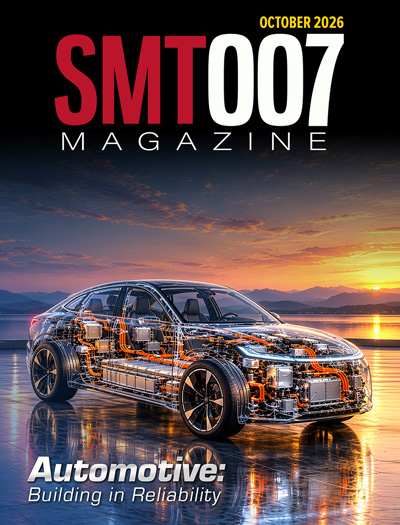
As electronic vehicles (EVs) become the norm, their internal architectures are evolving in parallel, growing smarter, more integrated, and vastly more complex. At the center of this transformation is the control system, the “central nervous system.” From managing energy flow to ensuring safety-critical operations, a trio of electronic brains—the vehicle control unit (VCU), the motor control unit (MCU), and the power distribution unit (PDU)—work in concert to orchestrate seamless propulsion, intelligent energy usage, and adaptive safety responses.
These units not only control but also enable the very functionality that defines the EV experience. They are mission‑critical and failure in any one can degrade performance, compromise safety, or result in vehicle downtime. They lie at the intersection of power electronics, thermal management, software/hardware integration, and system safety (ISO 26262, ASIL). Reliability of these controls is essential for scaling EV adoption because users expect long life, minimal maintenance, and high uptime, even much more so than in legacy ICE (internal combustion engine) vehicles.
The Vehicle Control Unit: A Mastermind of Modular Control
The VCU is responsible for high-level decisions across the entire EV powertrain. Much like the human brain coordinating bodily functions, the VCU collects data from sensors, communicates with subordinate controllers like the MCU and battery management system (BMS), and makes real-time decisions about torque delivery, braking behavior, thermal management, and energy recuperation.
To continue reading this article, which originally appeared in the December 2025 edition of SMT007 Magazine, click here.


