













 American Made Advocacy: Rebuilding America’s Military Stockpiles Begins With Microelectronics
 The Right Approach: The End of an Era—DoD Proposes MIL-PRF-31032 Cancellation
 Defense Speak Interpreted: Hypersonics Report Back After Six Years of Silence





IBM, UIUC Expand Discovery Accelerator for AI and Quantum Computing
April 20, 2026 | PRNewswireEstimated reading time: 4 minutes
IBM and the Grainger College of Engineering at the University of Illinois Urbana-Champaign (U. of I.) announced an expansion of the IBM-Illinois Discovery Accelerator Institute. This includes deploying quantum-centric supercomputing to Illinois innovators through the integration of U. of I.'s National Center for Supercomputing Applications (NCSA) Delta and DeltaAI supercomputers with IBM quantum computers.
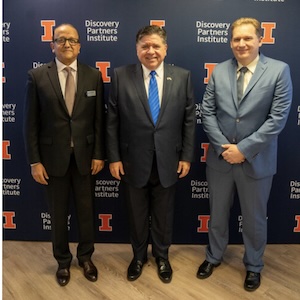
L-R: Rashid Bashir, Vice Chancellor for Chicago Strategic Partnerships, University of Illinois Urbana-Champaign, and Dean, The Grainger College of Engineering; Illinois Governor JB Pritzker; Jay Gambetta, Director of IBM Research and IBM Fellow (Credit: The Grainger College of Engineering, University of Illinois Urbana-Champaign)
L-R: Rashid Bashir, Vice Chancellor for Chicago Strategic Partnerships, University of Illinois Urbana-Champaign, and Dean, The Grainger College of Engineering; Illinois Governor JB Pritzker; Jay Gambetta, Director of IBM Research and IBM Fellow (Credit: The Grainger College of Engineering, University of Illinois Urbana-Champaign)
Launched in 2021, the Discovery Accelerator Institute has 20 current, ongoing projects across hybrid cloud, AI, quantum computing, materials discovery, and sustainability, and its members have published more than 230 research papers.
Moving into this new phase, the Institute will build on its first five years of technological progress in AI systems and computational science to shape how quantum computing and AI will drive the next generation of supercomputing. These new initiatives will include the development of new algorithms that enable classical and quantum systems to work together on problems neither can solve alone; as well as the creation of novel AI systems designed for emerging AI workloads and the use of AI to accelerate the design of specialized computing systems.
"I'm pleased to see the IBM-Illinois Discovery Accelerator Institute building on years of progress and partnership with U. of I. as Illinois innovators pursue critical discoveries in quantum computing and AI," said Governor JB Pritzker. "Illinois' world-class research institutions, unique industry collaborations, and unmatched research talent position our state at the forefront of global progress, and I look forward to seeing the countless advancements that this expansion will bring."
Advancing the next era of computing with systems, software, and algorithms
Quantum-centric supercomputing represents IBM's vision for the future of computation, where quantum processors (QPUs) work alongside high-performance classical systems powered by CPUs and GPUs to solve complex problems in science and industry. As part of the Institute's expansion, IBM and U. of I. researchers will collaborate on the development of quantum-centric workflow management tools to seamlessly integrate the most powerful IBM quantum computers on the cloud with NCSA Delta and DeltaAI supercomputers, creating an environment for ongoing quantum-centric supercomputing-powered research across academia, industry, and government in Illinois.
Institute members will explore how quantum-centric supercomputing architectures and novel algorithms can integrate the power of IBM quantum computers and NCSA HPC to solve classically hard problems and pursue near-term quantum advantage, as well as solutions for fundamental problems in chemistry, condensed-matter physics, and materials science.
In addition, over the next five years, the IBM-Illinois Discovery Accelerator Institute will push the frontiers in AI systems research by tackling challenges in the efficient, scalable, and adaptable distributed inference of next-generation AI workloads across diverse computing infrastructures. The Institute will also launch Algorithms-to-Silicon-to-Systems (AS2), a new research area to accelerate the integration and implementation of algorithms into silicon for specialized systems. AS2 will represent a shift toward a unified, AI-native design paradigm, where algorithms, silicon, and systems software are co-evolved, rather than developed in isolation. The results will be a step change in productivity, accessibility, and scalability to enable the rapid creation of complex, high-performance systems with strong guarantees of correctness, robustness, and real-world usability.
"IBM is thrilled to help provide quantum-centric supercomputing to Illinois researchers, alongside an expansion of the IBM-Illinois Discovery Accelerator Institute's efforts in AI for systems design. As the brilliant minds within the Institute discover and test new algorithms, they will drive groundbreaking research to power the applications made possible by AI and quantum computing," said Jay Gambetta, Director of IBM Research and IBM Fellow.
In addition to research, the expanded collaboration emphasizes education and workforce development. IBM, U. of I. will lead education initiatives aimed at building expertise across quantum computing, AI systems, and HPC. Through curriculum development, hands-on training, and collaborative research, IBM and U. of I. seek to develop the next generation of scientists and engineers equipped to advance heterogeneous computing architectures.
Together, these updated research priorities will keep U. of I. and the State of Illinois at the forefront of progress as a global hub for AI- and quantum computing-enabled scientific discovery, bridging theory and practice through tightly coupled hardware, software, and algorithm innovation.
IBM has a long-standing relationship with the State of Illinois' quantum ecosystem, including with the University of Chicago, members of the Chicago Quantum Exchange and the U.S. Economic Development Administration-designated Bloch Quantum Technology Hub. The company is also committed to leading the National Quantum Algorithm Center in the Illinois Quantum and Microelectronics Park (IQMP) in Chicago, which will be anchored by an IBM Quantum System Two, to be online later this year.
Deming Chen, IIDAI co-director and Abel Bliss Professor of Engineering at The Grainger College of Engineering: "Our goal with the expansion is to build on past successes and continue advancing the institute's impact. We aim to reach new heights in the next five years. Our students have expressed appreciation to both Illinois and IBM for involvement in a truly unique program. They benefit from working on-site at IBM — gaining access to advanced computing resources and mentorship by IBM colleagues — while continuing to make progress on their thesis."
Rashid Bashir, dean of The Grainger College of Engineering and vice chancellor of Chicago strategic partnerships with the University of Illinois Urbana-Champaign: "The Grainger College of Engineering is thrilled to host this flagship partnership with IBM to define the future of how AI, quantum and supercomputing will come together for the greatest impact. Additionally, the Institute's presence in Chicago at the Discovery Partners Institute (DPI) will allow for greater integration with IBM and the Chicago quantum ecosystem."
Susan Martinis, senior vice chancellor for research and innovation at the University of Illinois Urbana-Champaign: "Collaborative efforts like the IBM-Illinois Discovery Accelerator Institute foster strong connections and advance discovery in areas such as AI, quantum and supercomputing. The Institute is a wonderful example of how Illinois research partners with industry to create momentum and drive innovations that will change the world."
Share on:


Testimonial
"Your magazines are a great platform for people to exchange knowledge. Thank you for the work that you do."
Simon Khesin - Schmoll MaschinenSuggested Items
Xanadu, EV Group Partner to Build Industrial-Scale Photonic Quantum Hardware
05/05/2026 | PRNewswireXanadu Quantum Technologies Ltd., a leading photonic quantum computing company, and EV Group (EVG), a leading supplier of wafer bonding and lithography equipment, announced a strategic partnership to develop critical heterogeneous integration and wafer bonding processes to facilitate the scalability of photonic quantum systems.
Infineon Brings Industrialization Expertise to European Quantum Chip Pilot Lines
05/04/2026 | InfineonInfineon Technologies AG is a core industrial partner in accelerating Europe's move toward practical – and ultimately, commercially viable – quantum computing by contributing its world-class engineering and manufacturing expertise to three quantum pilot lines projects: SUPREME, CHAMP-ION and SPINS.
IBM, Dallara to Advance AI and Quantum-Powered Design for High-Performance Vehicles
05/01/2026 | IBMIBM and the Dallara Group, a world-leading racing and high-performance vehicle manufacturer, announced a collaboration to advance vehicle design and optimization using AI and explore the use of quantum computing.
Swinburne University, Siemens Launch Australia’s First Quantum Timing Study for Smarter Power Grids
04/30/2026 | SiemensSwinburne University of Technology and Siemens are undertaking first-of-its-kind research in Australia, into how quantum-enhanced timing can help future-proof the energy grid and increase grid stability.
Sygaldry Raises $139M to Build Quantum Computers for AI
04/22/2026 | SygaldrySygaldry Technologies, Inc. announced that it has raised $139M in Series A and Seed financing to build quantum-accelerated AI servers.