


















 Bridging the Pacific: What American and Asian PCB Companies Can Learn From Each Other
 Learning With Leo: The Study of Listening
 Nolan’s Notes: Automotive Is Gearing Up Again





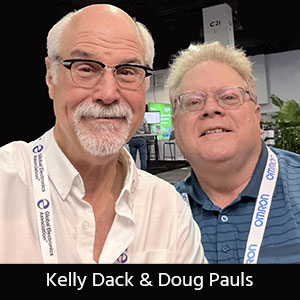
In electronics manufacturing, quality is often discussed in terms of specifications, standards, and process controls, but as industry veteran Doug Pauls reminds us, the stakes are far more human. In this conversation, Doug, a recipient of the Global Electronics Association’s Hall of Fame Award, draws on more than four decades of experience to illuminate the real-world consequences of reliability, where even a single defect can carry profound implications. He brings into sharp focus why quality isn’t just a metric, but a responsibility shared by everyone on the manufacturing floor.
Kelly Dack: Doug, I caught some of your Learning Lounge presentation at APEX EXPO, and aside from being well done, it really struck a chord. I want to know more, but first, tell us a little about your background.
Douglas Pauls: Thank you very much. Until two years ago, I was a senior technical fellow at Collins Aerospace (Rockwell Collins) in Cedar Rapids, Iowa. I turned 65 about two years ago and “retired,” but I'd worked 42 years to reach the top of my profession, and I had more to give. So, I started a consulting firm called “It Depends Electronics.”
Dack: I love that. What is the story behind the name?
Pauls: I'd been working on IPC specs and standards since 1985, and people would always come to me with the very broad question: “What’s a good flux?” That's too broad a question to answer. They aren’t all good fluxes or all bad fluxes.
Dack: So, you would say, “It depends,” which would lead you into a series of more focused questions?
Pauls: Yes. I used that response so much at work and within the Global Electronics Association that the phrase became associated with me. When I named my consulting firm, my colleagues said, “Perfect. That's exactly you.”
Dack: I would have to agree. Your presentation had several examples of “it depends” variables. Briefly, what did you cover? What are the challenges and solutions you see?
Pauls: The presentation itself was on conformal coating and defects, which must be fixed before you can ship the product. What causes the defects, and what can you do about them? Almost my entire career has been in electronics manufacturing. There are many things one sees out on the shop floor, real-life situations that help clearly explain a spec or a standard, that can’t be done as well in words.
There are many opinions on how to inspect conformal coating. There are different ways to approach it. My presentation focused on those things that you often see, where they come from, and what you can do about them.
Dack: You also included some striking visuals that led right into the quality aspect of your talk on conformal coating, including mentioning your son. Tell me about that.
Pauls: My son is a captain in the U.S. Army armored infantry, so he commands M1A2 Abrams Main Battle Tanks. It’s a sophisticated machine that contains a lot of printed circuits, many of which are conformally coated.
Dack: What was the story you told where you described going a little bit “papa bear” on some quality managers?
Pauls: Yes, I worked for Rockwell Collins on a variety of products for the military, such as battlefield information handling systems. One product we were developing was the Joint Tactical Information Distribution System. It exists so that the good guys know where all the good guys are and the bad guys are. Some of those electronics Collins makes go into the M1A2 tanks. That product had been built by Rockwell Collins for a long time and was being continually upgraded.
When I found out that my son's safety—his life—depended on how well that piece of our hardware worked, I went a little papa bear on the quality folks. That product was being built in a building next to my office, so I went through that process with a fine-tooth comb. The coating operators wondered what was going on.
They had all known me for a long time and said, “You’ve been focused on conformal coatings before, but you've never been a demon like this. Why?” I explained that this goes into an M1A2 tank, and my son's life may depend on it. They understood, and, quite interestingly, the defects from that line dropped by at least 50% for the next week.
Dack: What a great example of putting a real-life situation in context to affect our view of building quality. Would you like to give your son a shout-out?
Pauls: Yes. Hi, son! Stay safe!
Dack: And thank you for your service. Doug, you’re a great speaker and business owner. It has been a pleasure talking to you.
Pauls: My pleasure and thank you, Kelly.
Introduction to Conformal Coating
Meets Tuesdays & Thursdays, June 2 - June 25
12 p.m. PT / 3 p.m. ET
4 weeks
Register here and use discount code F5F5MS3U at checkout to receive 20% off one of our upcoming online instructor-led courses.


