








 It’s Only Common Sense: Win the Sale Before the RFQ Arrives
 The Marketing Minute: Marketing Is a Team Sport





As the world focuses on climate change and biodiversity loss, Foxconn Technology Group, the world's largest technology manufacturing platform service company, responded to the "International Day for Biological Diversity" on May 22 by announcing an investment of NT$ 20 million to promote the "Sustainable Ecological Project - Establishing Satoyama Academy" in Longtan, Taoyuan. The project has already accumulated rich ecological data! Integrating three core actions—biodiversity conservation, natural carbon sink research, and environmental education promotion—it creates a demonstration field for corporate participation in local ecological restoration and sustainable development, showcasing how technology companies are moving from carbon reduction to harmony with nature. This is also a concrete practice of Foxconn's " 2026-2030 Sustainable Long-Term Goals ."
Following its " Sustainable Ocean " project in 2023 , Foxconn is now extending its biodiversity commitment to the terrestrial level. Responding to international trends, the "Sustainable Ecology Plan" incorporates the concept of "Nature-based Solutions ( NbS )," exploring new models for corporate participation in natural capital management through scientific surveys, habitat creation, and cross-sectoral collaboration. This elevates the sustainability strategy from "reducing impact" to "creating positive impact."
Regarding biodiversity, Foxconn began a systematic survey of the area surrounding Longtan in Taoyuan last year. Through cross-line surveys, sampling point monitoring, and infrared automatic photography, they have continuously accumulated local ecological data. The survey results show that the area encompasses diverse habitats including forests, farmland, ponds, and streams, and has recorded a variety of mammals, birds, amphibians, reptiles, insects, and plants. These include protected species such as pangolins, crab-eating mongooses, forest eagles, crested goshawks, Formosan blue magpies, and Taipei tree frogs, as well as several species endemic to Taiwan, demonstrating the area's important position in the regional ecological network. In the future, the team will promote habitat improvement measures, including setting up bird and bat nest boxes, replanting native plants, and removing invasive alien species to enhance habitat quality and ecosystem stability.
Regarding natural carbon sequestration, Foxconn has partnered with the Department of Agricultural Chemistry at National Taiwan University to conduct soil carbon sequestration surveys and enhancement experiments in the Longtan area. Through soil profile observations, physicochemical property analysis, and carbon pool inventory, basic data on local soil carbon storage have been established. Field trials have been designed to explore the impact of different soil management practices on carbon storage, while also exploring sustainable agricultural models that combine agricultural production and carbon sequestration benefits.
In addition, the project also incorporates visible to near-infrared spectroscopy ( Vis-NIR ) technology, combined with artificial intelligence and machine learning models, to develop a rapid prediction method for soil carbon content. Compared with traditional laboratory analysis, this significantly improves monitoring efficiency and provides innovative tools and scientific basis for future farmland carbon sequestration management and carbon inventory.
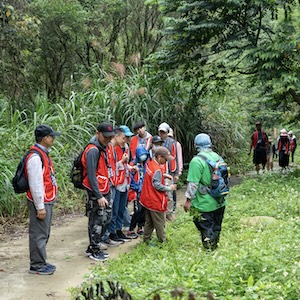
In terms of environmental education promotion, "Satoyama Academy" uses the Longtan Jilongkeng Trail as its core venue, combining the local natural environment and the ecological characteristics of the four seasons to design gamified and scenario-based teaching content, creating a natural education platform for parents and children to learn together. In the past year, it has invited nearly 300 Foxconn employees and their families to participate, transforming ecological knowledge into intuitive and participatory learning experiences, allowing employees to work together to build an understanding and appreciation of the natural environment.
At the same time, the plan also promotes a multi-level cultivation strategy, establishing cross-sectoral connections through corporate employee participation, primary and secondary school teacher training, and community cooperation. Through environmental education activities and guided tour training courses, it cultivates seed teachers and volunteers with ecological knowledge and interpretation skills, further spreading the concept of sustainability to schools and communities, forming an impact from the inside out.
Hung Jung-tsung, Chief Environmental Officer of Foxconn, said, "While pursuing growth, companies must also rethink their relationship with nature. In recent years, Foxconn has actively extended its carbon reduction efforts to issues of natural capital and biodiversity. Through the Sustainable Ecology - Satoyama Academy Project, we hope to establish a practical field for the coexistence and prosperity of humans and nature, so that sustainability is not just a goal and a promise, but a concrete action that can be participated in and experienced."
Hung Jung-tsung further pointed out that for enterprises, promoting sustainable transformation is not only about risk management, but also an important opportunity to create long-term value. Through cooperation with academic institutions and local communities, Foxconn is gradually establishing a sustainable model that combines scientific research, local practice, and education promotion. It hopes to leverage the group's influence to expand the application scope of nature-based solutions and connect more partners to participate in ecological protection.
Looking to the future on "International Day for Biological Diversity," Foxconn will continue to deepen the demonstrative function of its Satoyama Academy, combining digital technology to guide the large-scale promotion of Nature-Based Solutions ( NbS ), enhancing site management and educational effectiveness. This concrete action demonstrates the company's commitment to transforming from "reducing environmental impact" to "creating positive environmental benefits." Moving forward, Foxconn will continue to work with industry, government, academia, and the public to jointly move towards a sustainable future where humanity and nature coexist harmoniously.