














 Bridging the Pacific: What American and Asian PCB Companies Can Learn From Each Other
 Learning With Leo: The Study of Listening
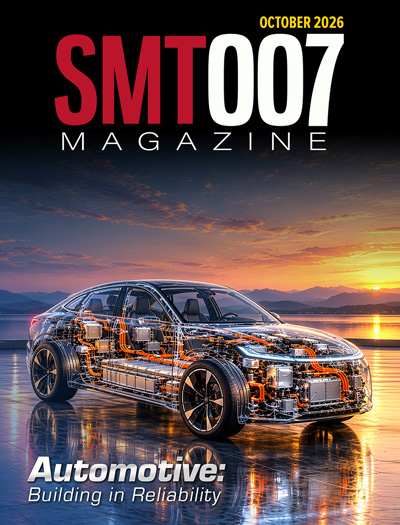
 Nolan’s Notes: Automotive Is Gearing Up Again





TrendForce's recent memory pricing survey shows that more mature NAND process capacity is being shifted toward higher-value products like high-layer-count 3D NAND, leading to a significant shortage of MLC NAND supply. As a result, some industrial, automotive, and networking clients are considering switching to SLC NAND, further tightening the already limited market.
Meanwhile, demand for SLC NAND continues to grow in AI edge computing, data centers, and automotive electronics, causing the supply-demand gap to widen quickly. TrendForce predicts SLC NAND contract prices will rise by 120–170% in the second half of 2026 compared to the first half, with potential for even greater increases.
TrendForce notes that MLC NAND contract prices reached record highs during the first half of 2026, prompting some buyers to adopt a more cautious procurement strategy. However, industrial and automotive customers remain bound by stringent qualification requirements and fixed memory specifications, leaving them with little flexibility to reduce purchases.
Faced with severe supply shortages and sharply rising costs, some customers that previously used low- to mid-density MLC NAND have begun migrating to 4Gb and 8Gb SLC NAND devices, which offer greater reliability and a longer endurance of 100,000 program/erase (P/E) cycles.
Beyond the MLC migration effect, demand across SLC NAND's four major niche application segments is accelerating and has created a strong foundation of structural demand. In AI edge computing and high-end networking, the rapid deployment of real-time AI inference at the edge is driving shipments of smart factory equipment, autonomous mobile systems, and next-generation network switches—all of which rely on SLC NAND to enable fast booting of mission-critical real-time operating systems.
Continued investment in network infrastructure and data centers is driving substantial demand for SLC NAND as boot drives and write-intensive buffers. In automotive electronics and smart home systems, SLC NAND provides the continuous, error-free read/write performance required for mission-critical operation. In highly demanding environments such as medical imaging, aerospace, and defense, where data integrity is paramount, SLC NAND remains the only technology capable of delivering long-term data retention with the required level of reliability.
TrendForce points out that none of the major global SLC NAND suppliers plan to add new production capacity in the near term. Instead, manufacturers are focusing on process shrinks, yield improvements, and optimizing output per wafer. Against a backdrop of growing MLC-to-SLC migration and surging demand from traditional niche applications, the SLC NAND market is expected to enter a period of structural undersupply in the second half of 2026.
Seasonal inventory replenishment in the third quarter, coupled with continued reductions in mature-node NAND production and depleted inventories in the fourth quarter, is expected to further tighten supply. Consequently, overall SLC NAND prices are projected to rise by 120–170% in the second half of 2026 compared with the first half, with additional upward revisions remaining possible.


