











 Flex Connections: Material Selection in Nickel vs. Copper Tabs
 Flex Connections: Four Lessons in Engineering Judgment for PCB Designers
 Flexible Thinking: ‘Let There Be Light’–Emitting Diodes!






Marcy’s Musings: A World of Difference
I've spent a good deal of time in Asia over the years, both traveling and living there, so arriving in Thailand for THECA wasn't my first experience stepping into another culture or another way of doing business. Still, there is something about being there—moving through a different city, sitting down with people, listening to their conversations, and watching how they approach familiar challenges—that gets me thinking.
Then I come home. I return to my own routines, my own desk, and the people and places I know well. But every time I travel internationally, I return seeing things a little differently. It has a way of reminding me that the way something is done in my corner of the world isn't necessarily the only way, or even always the best way. Sometimes you need to get outside your own space to see that. (Be sure to read Stephen Chavez’s article in this issue about how working with a global team taught him some valuable communication skills.)
I've been thinking about this new perspective as we've put together this month's issue, because we're taking you outside some familiar spaces, too. In particular, we're looking to Europe, where PCB designers in Italy, France, Germany, and elsewhere are dealing with many of the same challenges designers face around the world, but they're also working within their own markets, cultures, organizations, and priorities. The articles in this issue on the PCB design communities, technical events, award ceremonies, and standards development in Europe provide real-time updates on how designers are approaching and overcoming these challenges.
Their experiences matter, particularly as our industry works toward standards and solutions intended to serve a global electronics community. Those ideas are also evident in my refreshing interview with Dominik Grau, the new vice president for Europe at the Global Electronics Association, whose impressive CV traces the evolution of standards in our fast-changing industry.
There's another idea running through this issue about the growing role of AI and automation in our work. What is the role of employees and empowerment? Our contributors aren't warning us about AI replacing people. Quite the opposite. They show how AI and automation are already being put to work on the shop floor, helping manufacturers analyze information, identify problems, improve processes, and do things faster and more consistently. Those are powerful capabilities.
But the technology becomes even more valuable when it's paired with the experience of the people using it. Someone who has spent years designing boards or working on a factory floor brings context to what the data is saying. We offer perspectives from Michael Gleason at GreenSource Fabrication, Sean Patterson, and columnists Steve Williams and Don Ball, demonstrating the importance of knowing which questions to ask, when something doesn't look right, and when a solution that works perfectly in one situation may not work in another.
In his column, Steve Williams reflects on some of the great thinkers in quality and continuous improvement, suggesting that these leaders would have embraced AI. “None of these six would treat AI as a replacement for the discipline they spent their careers building. Each would use it to do what they already believed in, faster and at greater scale,” he writes.
In other areas of interest, Anaya Vardya explores flexible circuits in nanosatellites, Michael Carano explains some of the challenges of producing reliable microvias in HDI builds, Shane Whiteside argues for American-made PCBs in American data centers, and Brian Buyea explores what designers get wrong about designing for reliability. Laurent Nicolet of SCHMID discusses the convergence between PCB fabrication and semiconductor processing. Finally, enjoy my interview with Aiden Neary, CEO of Xscindo, a company changing the way we approach circularity in electronics.
In some ways, the lessons brought home from traveling can be applied to how we do our work each day. The more perspectives we bring to a problem, and the more willing we are to learn from them, the better our decisions become. The real opportunity comes from putting those different kinds of knowledge to work together.
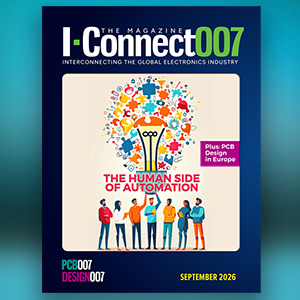
This column originally appeared in the September 2026 issue of I-Connect007 Magazine.


