













 Global Sourcing Spotlight: Finding Your Greatest Sourcing Asset in Partnerships
 Knocking Down the Bone Pile: Hot Air vs. Infrared PCB Rework
 Nolan’s Notes: Why Mexico’s Time Has Come





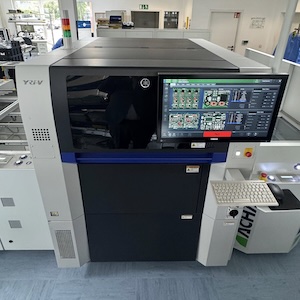
A lack of floorspace and legacy constraints could have prevented design and manufacturing specialist Miltronik from taking the next step in continuously improving production capabilities. Yamaha Robotics’ YRi-V dual-lane AOI system overcame that barrier and enabled the company to go further by upgrading two assembly lines in the space of one.
Miltronik’s headquarters in Hilden, Germany, houses design, logistics, and advanced manufacturing capabilities in the same site that has served the company since 1986. The team conceives, develops, and produces electronic control systems, operating units, communication systems, and instrumentation for equipment like road construction machinery, e-bikes, railway systems, commercial catering systems. The company has built a loyal customer base in sectors including manufacturing and process industries, agricultural, medical, pharmaceuticals, and transportation.
The factory is setup to build prototypes, pre-series, and production runs from about 250,000 units per year, combining surface-mount and through-hole capabilities, hand wiring, and other processes like sealing and 3D printing. By choosing high-qualty, reliable equipment, including Yamaha mounters, the company now has two surface-mount assembly lines that provide the capabilities and capacity to handle all production requirements.
“We have owned a Yamaha YS12 mounter since we set up our first surface-mount line, and chose two YSM20 mounters from Yamaha when the opportunity came to invest in a second line,” says David Kimmerle, General Manager and Partner at Miltronik. “That YS12 is so strong and dependable that we continue to use it to this day.”
Opportunity to Advance
The production team has always seen Automatic Optical Inspection (AOI) as the foundation stone for quality control. “AOI can check each assembly immediately after reflow, finding and localising any issues for us to check and in addition giving insights about the causes,” explains David Kimmerle. “When we saw Yamaha’s latest YRi-V 3D AOI, it was obviously a significant step forward with the potential to upgrade our capabilities further.”
David and the production team began planning to invest in a YRi-V as a replacement for the inline AOI already installed in their primary SMT line. With the YRi-V in place, the older system would then move from the main line to the second line. However, there was insufficient space to house two full SMT lines, each containing its own independent AOI. At this point, the plan to upgrade line 2 may have stalled leaving the company unable to maximise the value of its new capital investment. But the YRi-V delivers another ace: the optional dual-lane configuration, with two fully independent sets of rails, can handle boards of different sizes and lets each lane change to a different product at any time. It provides the ultimate flexibility for production planning with true, two-in-one space-efficiency.
All the team needed was a custom right-angle conveyor to transfer populated assemblies from the two SMT lines into reflow, moving in parallel to each other. After this soldering process, the boards move directly into the dual-lane YRi-V for inspection. In addition to utilising factory floorspace efficiently, this approach also let the team take advantage of identical state-of-the-art AOI in both SMT lines. The result gives complete flexibility to assign any job to the most suitable line, depending purely on assembly capabilities and availability.
Dual-Lane Flexibility, Faster Programming
The dual-lane model, YRi-V DL, can inspect large boards up to 610mm long x 320mm wide in each lane at the same time. By allowing rails 2, 3, and 4 to move independently, the YRi-V can handle large and small PCBs in each lane simultaneously. With maximum movement range of 640mm, the largest board can be up to 590mm wide, if the smallest is 50mm. If both lanes have small boards, it’s possible to move all rails to the front side thereby reducing the necessary X-Y head excursion to minimise inspection cycle time.
The YRi-V can operate standalone or inline with surface-mount equipment from any manufacturer. The system is supplied with a ready-to-use parts library containing thousands of components, free of charge, and the YRi-V also makes it easy to generate parts data from drawings and ODB++ files. Programming is even easier for companies that already operate Yamaha equipment like Miltronik’s YSM20 machines, as component data already created for the mounters can be re-used. Miltronik was able to use existing mounter programs as a source for the AOI programs, avoiding any extra CAD data migration.
There is also a parts-creation wizard for handling unusual or non-standard components, and Yamaha has recently introduced AI-powered image matching that helps build libraries even more quickly and efficiently. In addition, automatic setting of parameters including inspection area and lighting, with automatic position correction, cut data tuning time by as much as 50%. Together, these features let YRi-V owners accelerate new product introduction, enabling a faster turnaround for customer orders.
“The AI assisted component database creation, as well as the integrated and powerful tools to tune the AOI programs, helps users generate production-stable AOI programs extremely quickly and unleash the full potential of the YRi-V in their manufacturing,” comments Andreas Grünewald, Inspection Machine Team Manager, Yamaha Robotics.
Feature-Rich Platform
All YRi-V systems feature a high optical specification, with multi-angle, multi-wavelength projectors, special low-angle cameras to capture fine details that can otherwise be shadowed by large components, and illumination with white LEDs that aids image analysis by capturing true colours. Other powerful features help maximise accuracy and cut inspection cycle time, including fillet recognition, height measurement range up to 25mm, automatic alignment checking of grouped parts like an LED matrix, and stopperless transfer that cuts board positioning time.
Among the suite of offline software tools available for the YRi-V, Miltronik is using the Repair Station which helps analyse inspection results and images of rejected boards to confirm or reject the result. Further strengthening support for post-inspection checking, Yamaha has recently introduced new AI secondary judgement software that lets users train models using their own production data. Miltronik also chose the optional marker unit, which can inscribe characters as small as 3mm high on the substrate after inspection to assist with identification.
“We have sustained our long-term connection with Miltronik by delivering high-performing and reliable technology as well as first-class support,” comments Ulf Neyka: Key Account Consultant, Yamaha Robotics. “We were able to understand the team’s wishes, as they planned to invest in advanced AOI, and deliver a solution leveraging our YRi-V system. The dual-lane flexibility and time-saving programming tools were critical to the success of this project.”


