





U.S. Navy Awards General Dynamics $322M for Nuclear-Submarine Support Work
September 17, 2015 | General DynamicsEstimated reading time: 1 minute
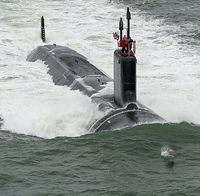
The U.S. Navy has awarded a $321.7 million contract option to General Dynamics Electric Boat to provide planning yard work, engineering and technical support for nuclear submarines. Electric Boat is a wholly owned subsidiary of General Dynamics.
Under this option, Electric Boat will provide design, engineering, material and logistics support, and research and development activities for active U.S. submarines and submersibles. Electric Boat also will provide information services, planning, scheduling and technical support for submarine maintenance and modernization activities, training and facility support, and affordability/cost reduction support.
The contract will be worth approximately $1.5 billion over five years if all options are exercised and funded.
This work will engage Electric Boat's engineering and design organization, which comprises more than 4,400 employees. Possessing proven technical capabilities, these employees work on all facets of the submarine life cycle from concept formulation and design through construction, maintenance and modernization, and eventually to inactivation and disposal.
Electric Boat has established standards of excellence in the design, construction and life-cycle support of U.S. Navy submarines. In its position as an industry leader, Electric Boat remains committed to advancing its technical strengths, while providing the business expertise to effectively manage the challenges of nuclear-submarine production. The company's primary locations are in Groton, Conn., New London, Conn., and Quonset Point, R.I. Its current workforce is approximately 14,000 employees.
Testimonial
"We’re proud to call I-Connect007 a trusted partner. Their innovative approach and industry insight made our podcast collaboration a success by connecting us with the right audience and delivering real results."
Julia McCaffrey - NCAB GroupSuggested Items
Teradyne Acquires TestInsight, Accelerating Time to Market for AI and Data Center Devices
04/16/2026 | BUSINESS WIRETeradyne, Inc., a leading provider of automated test equipment (ATE) and advanced robotics, announced it has acquired TestInsight, a leading provider of semiconductor test development, validation, and conversion software widely used across the industry.
Cadence, Google Scale AI Chip Design with ChipStack on Google Cloud
04/16/2026 | Cadence Design SystemsCadence, an industry leader in AI-driven computational software for semiconductor and system design, announced a strategic collaboration with Google to optimize the Cadence® ChipStack™ AI Super Agent with Gemini on Google Cloud.
ESD Alliance Reports Electronic System Design Industry Posts $5.5 Billion in Revenue in Q4 2025
04/15/2026 | SEMIElectronic System Design (ESD) industry revenue increased 10.3% to $5,466.3 million in the fourth quarter of 2025 from the $4,955.2 million registered in the fourth quarter of 2024, the ESD Alliance, a SEMI Technology Community, announced today in its latest Electronic Design Market Data (EDMD) report.
April Issue of I-Connect007 Magazine: Beyond the Rulebook
04/14/2026 | I-Connect007 Editorial TeamIn this month’s I-Connect007 Magazine, we asked PCB designers, fabricators, and suppliers what it really means to operate without a rulebook. Their perspectives vary, especially between seasoned designers and experienced fabricators, but a common thread emerges: progress depends on pushing boundaries and finding a way forward, even when the path isn’t clear. In many ways, this mindset has always been part of what we do, whether we’ve called it that or not.
Powering the Future: Why Thermal Management Defines the Future of Electronics
04/15/2026 | Brian Buyea -- Column: Powering the FutureEvery leap forward in electronics comes with a familiar consequence: heat. Whether it’s a power module driving an electric vehicle, a laser diode used in surgery, or a 5G amplifier operating in orbit, higher performance inevitably means higher temperatures. While engineers celebrate breakthroughs in speed, density, and power, none of those specifications matter if the system can’t keep cool long enough to perform reliably.