














 Dan’s Biz Bookshelf: ‘Building a Story Brand 2.0’
 It’s Only Common Sense: Why Should They Take Your Call?





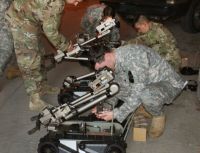
U.S. Army science and technology advisors have initiated a project to field a robot capable of assessing chemical, biological, radiological, nuclear, explosives, or CBRNE, threats from a safe distance.
Several Army organizations combined on a new variant of the PackBot 510 robot with enhanced CBRNE detection capabilities.
"These robots are one-of-a-kind and filled a critical gap for Soldiers on the front lines in Korea," said Lt. Col. Mark Meeker, field assistance in science and technology advisor assigned to U.S. Forces Korea.
The robots provide the 2nd Infantry Division's 23rd Chemical Battalion with a remote, first-look capability in underground facilities, Meeker said.
Three U.S. Army Research, Development and Engineering Command, or RDECOM, science advisors from RDECOM-Pacific combined to facilitate the project. Science advisor James Koh initiated the process through an industry partnership.
"We leveraged an existing cooperative research and development agreement to integrate RDECOM's expertise with a contractor that builds robots," Koh said. "This opportunity is open to all comers and leverages the best of what industry has to offer."
The yearlong effort included RDECOM; Program Executive Office for Combat Support/Combat Service Support, or PEO/CS/CSS, and the Rapid Equipping Force, or REF.
RDECOM's Tank Automotive Research, Development and Engineering Center built a prototype robot, and contractor iRobot began exploring tunnel training areas in South Korea.
"We conducted a technical demonstration at the 2nd Infantry Division's Micro Experiment," said RDECOM-Pacific science advisor Richard Moore, who facilitated the demonstration on behalf of RDECOM. "Once they saw the technology, they were completely on board."
Page 1 of 2