















 Flex Connections: Four Lessons in Engineering Judgment for PCB Designers
 Flexible Thinking: ‘Let There Be Light’–Emitting Diodes!
 Target Condition: Flex and Rigid-flex Solutions in A&D Display Electronics





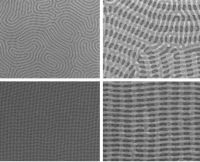
Since the 1960s, computer chips have been built using a process called photolithography. But in the past five years, chip features have gotten smaller than the wavelength of light, which has required some ingenious modifications of photolithographic processes. Keeping up the rate of circuit miniaturization that we’ve come to expect — as predicted by Moore’s Law — will eventually require new manufacturing techniques.
Block copolymers, molecules that spontaneously self-assemble into useful shapes, are one promising alternative to photolithography. In a new paper in the journal Nature Communications, MIT researchers describe the first technique for stacking layers of block-copolymer wires such that the wires in one layer naturally orient themselves perpendicularly to those in the layer below.
The ability to easily produce such “mesh structures” could make self-assembly a much more practical way to manufacture memory, optical chips, and even future generations of computer processors.
“There is previous work on fabricating a mesh structure — for example our work,” says Amir Tavakkoli, a postdoc in MIT’s Research Laboratory of Electronics and one of three first authors on the new paper. “We used posts that we had fabricated by electron-beam lithography, which is time consuming. But here, we don’t use the electron-beam lithography. We use the first layer of block copolymer as a template to self-assemble another layer of block copolymer on top of it.”
Tavakkoli’s co-first-authors on the paper are Sam Nicaise, a graduate student in electrical engineering, and Karim Gadelrab, a graduate student in materials science and engineering. The senior authors are Alfredo Alexander-Katz, the Walter Henry Gale Associate Professor of Materials Science and Engineering; Caroline Ross, the Toyota Professor of Materials Science and Engineering; and Karl Berggren, a professor of electrical engineering.
Page 1 of 3
Share on:


Testimonial
"Our marketing partnership with I-Connect007 is already delivering. Just a day after our press release went live, we received a direct inquiry about our updated products!"
Rachael Temple - AlltematedSuggested Items
Indium Promotes Chris Bastecki to Business Unit Vice President
09/11/2026 | Indium CorporationIndium Corporation is pleased to announce the promotion of Chris Bastecki to Business Unit Vice President, Americas Sales & Service and Global Printed Circuit Board (PCB) Assembly Materials Marketing.
I-Connect007 Editor’s Choice: Five Must-Reads for the Week
09/11/2026 | Marcy LaRont, I-Connect007I feel compelled to start off by recognizing that today marks the 25th anniversary of the tragic activities that took place on 9/11/2001. Like so many of us, I will never forget exactly where I was and what I was doing when I heard that United flights 11 and 175 had struck the World Trade Center in NYC. That day, the world was forever changed, and the effects still reverberate. Today, I am taking a moment to remember the lives lost and the heroism and coming together that day brought about.
MacDermid Alpha Addresses Growing Demands for Electronics Reliability and Manufacturing Performance at Productronica India 2026
09/10/2026 | MacDermid AlphaMacDermid Alpha Electronics Solutions will highlight advanced materials engineered to improve reliability, process consistency and performance in increasingly complex electronics applications at Productronica India 2026, September 16-18, at the Bangalore International Exhibition Centre in Bengaluru.
I-Connect007 Launches New Qnity Podcast Series, ‘Engineering What’s Next’
09/10/2026 | I-Connect007I-Connect007 is pleased to announce the launch of On the Line With… Qnity: Engineering What’s Next, a new six-part podcast series exploring the materials science and engineering innovations shaping the next generation of electronics. The inaugural episode, “Inside Qnity’s Materials Science Legacy,” features Jake Joo, global technology director for Advanced Flex Technologies. In conversation with host Marcy LaRont, Joo discusses Qnity’s heritage, the evolution of its Advanced Flex Technologies business, and the history behind well-known material platforms such as Kapton® polyimide films and Pyralux® flex circuit laminates and adhesive systems.
Built Here, and Ready for What’s Next
09/08/2026 | Laura Martin, IsolaThe rise of drones is no longer on the horizon. Unmanned systems have rapidly changed the modern battlefield, demonstrating the value of platforms that can sense, communicate, process information, and act at unprecedented speed. But as development and production of these systems accelerate, another mission-critical consideration is coming into focus: the supply chain behind the electronics. U.S. defense policy is focusing on reducing dependence on covered foreign sources for unmanned systems and their critical components. The message to the defense industrial base is becoming clear: Resilient, trusted supply chains matter, and the electronics inside tomorrow's unmanned platforms are part of that equation.