















 It’s Only Common Sense: Make Your ‘Account’ the Whole Organization
 Dan’s Biz Bookshelf: ‘Building a Story Brand 2.0’





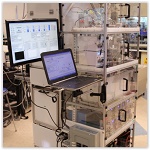
MIT researchers have developed a compact, portable pharmaceutical manufacturing system that can be reconfigured to produce a variety of drugs on demand.
Just as an emergency generator supplies electricity to handle a power outage, this system could be rapidly deployed to produce drugs needed to handle an unexpected disease outbreak, or to prevent a drug shortage caused by a manufacturing plant shutdown, the researchers say.
“Think of this as the emergency backup for pharmaceutical manufacturing,” says Allan Myerson, an MIT professor of the practice in the Department of Chemical Engineering. “The purpose is not to replace traditional manufacturing; it’s to provide an alternative for these special situations.”
Such a system could also be used to produce small quantities of drugs needed for clinical trials or to treat rare diseases, says Klavs Jensen, the Warren K. Lewis Professor of Chemical Engineering at MIT.
“The goal of this project was to build a small-scale, portable unit that was completely integrated, so you could imagine being able to ship it anywhere. And as long as you had the right chemicals, you could make pharmaceuticals,” Jensen says.
Jensen, Myerson, and Timothy Jamison, the head of MIT’s Department of Chemistry, are the senior authors of a paper describing the new system in the March 31 online edition of Science. The lead author is MIT research associate Andrea Adamo.
More flexibility
Traditional drug manufacturing, also known as “batch processing,” can take weeks or months. Active pharmaceutical ingredients are synthesized in chemical manufacturing plants and then shipped to other sites to be converted into a form that can be given to patients, such as tablets, drug solutions, or suspensions. This system offers little flexibility to respond to surges in demand and is susceptible to severe disruption if one of the plants has to shut down.
Many pharmaceutical companies are now looking into developing an alternative approach known as flow processing — a continuous process that is done all in one location. Five years ago, an MIT team that included Jamison, Jensen, and Myerson demonstrated a larger prototype (24 by 8 by 8 feet) for the continuous integrated manufacturing of drugs from chemical synthesis to tablets. That project has ended, but the continuous manufacturing initiative, funded by Novartis, is still underway as the researchers develop new methods for synthesis, purification, and formulation.
In the new endeavor, funded by the Defense Advanced Research Projects Agency (DARPA), the MIT researchers built on what they learned from the Novartis-funded project to create a much smaller, transportable device. Their new system can produce four drugs formulated as solutions or suspensions — Benadryl, lidocaine, Valium, and Prozac. Using this apparatus, the researchers can manufacture about 1,000 doses of a given drug in 24 hours.
Key to the continuous system is the development of chemical reactions that can take place as the reactants flow through relatively small tubes as opposed to the huge vats in which most pharmaceutical reactions now take place. Traditional batch processing is limited by the difficulty of cooling these vats, but the flow system allows reactions that produce a great deal of heat to be run safely.
“In many cases we were developing syntheses of targets that had never been done in a continuous flow platform,” Jamison says. “That presents a lot of challenges even if there is a good precedent from the batch perspective. We also recognized it as an opportunity where, because of some of the phenomena that one can leverage in [a flow-based system], you can make molecules differently.”
Page 1 of 2
Share on:



Subscribe
Stay ahead of the technologies shaping the future of electronics with our latest newsletter, Advanced Electronics Packaging Digest. Get expert insights on advanced packaging, materials, and system-level innovation, delivered straight to your inbox.
Subscribe now to stay informed, competitive, and connected.
Suggested Items
Dymax to Showcase PCB Protection and Thermal-Stress Solutions at SMTA Guadalajara
09/25/2026 | DymaxDymax, a global manufacturer of light-curing adhesives and equipment, will exhibit at SMTA Guadalajara, October 7-8, booth 830, where visitors can discover light-curing solutions designed to help manufacturers improve efficiency, reliability, and process performance.
Tata Electronics, Enomoto Sign MoU to Strengthen India Semiconductor Packaging
09/24/2026 | Tata ElectronicsTata Electronics, a pioneering leader in India’s electronics and semiconductor manufacturing sector, and Enomoto Co., Ltd., a leading Japanese precision semiconductor component manufacturer, have signed a Memorandum of Understanding (MoU) to advance the semiconductor packaging ecosystem in India, and support Tata Electronics’ packaging facility in Jagiroad, Assam.
SMART Photonics, GlobalFoundries Partner on Open-Access Silicon-Photonics Foundry Service
09/24/2026 | GlobalFoundriesSMART Photonics B.V. announced its partnership with GlobalFoundries (GF) to offer a new open access foundry service combining GF’s scalable and production-proven silicon platform with SMART Photonics’ high-volume indium phosphide photonic integrated circuits (PICs), including lasers and modulators.
Merlin Flex Continues to Invest in Long Flex
09/24/2026 | Merlin Flex LtdMerlin Flex Ltd has continued its investment into the manufacture of its long flex capability with a new oil-heated vacuum lamination press with a bonding area of 1800mm by 750mm.
Lyntris Qualifies SPY-6 Radar Assembly for Naval Supply Chain
09/24/2026 | PRNewswireLyntris Inc., a defense technology company delivering sense-to-act connectivity solutions for the modern, connected battlespace, announced that it has completed qualification of a critical hardware assembly supporting Raytheon's SPY-6 family of radars.