















 It’s Only Common Sense: How AI Consumes the Electronics Supply Chain
 Dan’s Biz Bookshelf: ‘Building a Story Brand 2.0’





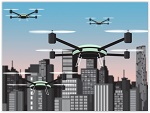
Planning algorithms for teams of robots fall into two categories: centralized algorithms, in which a single computer makes decisions for the whole team, and decentralized algorithms, in which each robot makes its own decisions based on local observations.
With centralized algorithms, if the central computer goes offline, the whole system falls apart. Decentralized algorithms handle erratic communication better, but they’re harder to design, because each robot is essentially guessing what the others will do. Most research on decentralized algorithms has focused on making collective decision-making more reliable and has deferred the problem of avoiding obstacles in the robots’ environment.
At the International Conference on Robotics and Automation in May, MIT researchers will present a new, decentralized planning algorithm for teams of robots that factors in not only stationary obstacles, but moving obstacles, as well. The algorithm also requires significantly less communications bandwidth than existing decentralized algorithms, but preserves strong mathematical guarantees that the robots will avoid collisions.
In simulations involving squadrons of minihelicopters, the decentralized algorithm came up with the same flight plans that a centralized version did. The drones generally preserved an approximation of their preferred formation, a square at a fixed altitude — although to accommodate obstacles the square rotated and the distances between drones contracted. Occasionally, however, the drones would fly single file or assume a formation in which pairs of them flew at different altitudes.
“It’s a really exciting result because it combines so many challenging goals,” says Daniela Rus, the Andrew and Erna Viterbi Professor in MIT’s Department of Electrical Engineering and Computer Science and director of the Computer Science and Artificial Intelligence Laboratory, whose group developed the new algorithm. “Your group of robots has a local goal, which is to stay in formation, and a global goal, which is where they want to go or the trajectory along which you want them to move. And you allow them to operate in a world with static obstacles but also unexpected dynamic obstacles, and you have a guarantee that they are going to retain their local and global objectives. They will have to make some deviations, but those deviations are minimal.”
Rus is joined on the paper by first author Javier Alonso-Mora, a postdoc in Rus’ group; Mac Schwager, an assistant professor of aeronautics and astronautics at Stanford University who worked with Rus as an MIT PhD student in mechanical engineering; and Eduardo Montijano, a professor at Centro Universitario de la Defensa in Zaragoza, Spain.
Page 1 of 2
Share on:



Subscribe
Stay ahead of the technologies shaping the future of electronics with our latest newsletter, Advanced Electronics Packaging Digest. Get expert insights on advanced packaging, materials, and system-level innovation, delivered straight to your inbox.
Subscribe now to stay informed, competitive, and connected.
Suggested Items
Aegis Software Introduces AI-Powered Interaction for Process Simulation and Planning in Simio
09/23/2026 | Aegis SoftwareAegis Software, a global provider of manufacturing execution, simulation and planning software, announced built-in Model Context Protocol (MCP) support in Simio.
Keysight Accelerates AttoTude IC Design Cycles by Over 50%
08/28/2026 | BUSINESS WIREKeysight Technologies, Inc. announced that AttoTude Inc., a pioneer of next-generation ASICs over Dielectric interconnect technology for AI and hyperscale data center applications, has expanded its use of Keysight EDA software to manage its full IC design workflow.
Sarla Aviation Scales Urban Air Mobility with Siemens Xcelerator
08/07/2026 | SiemensSiemens announced that Sarla Aviation is using the Siemens Xcelerator portfolio of industry software to accelerate the development of its next-generation electric vertical take-off and landing (eVTOL) aircraft for urban air mobility.
IEEE Study Demonstrates Full-Wave Simulation of Kerr Frequency Comb Generation
08/03/2026 | PRNewswireKerr optical frequency combs are compact light sources used in many applications, including precision measurements to high-speed communications.
Synopsys Showcases Autonomous Engineering with NVIDIA
07/28/2026 | PRNewswireAt the 2026 DAC Chips to Systems Conference, Synopsys, Inc. announced advancements to agentic AI for engineering in collaboration with NVIDIA.