













 It’s Only Common Sense: Hire for Hunger, Train for Skill
 Dan’s Biz Bookshelf: ‘The 'NVIDIA Way: Jensen Huang and the Making of a Tech Giant’





New Design Improves Performance of Flexible Wearable Electronics
June 23, 2017 | NC State UniversityEstimated reading time: 2 minutes
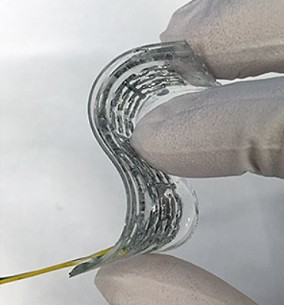
In a proof-of-concept study, North Carolina State University engineers have designed a flexible thermoelectric energy harvester that has the potential to rival the effectiveness of existing power wearable electronic devices using body heat as the only source of energy.
Liquid metal in the flexible thermoelectric device allows for self-healing. Rigid devices do not have the ability to heal themselves. Photo courtesy of Mehmet Ozturk, NC State University.
Wearable devices used to monitor a variety of health and environmental measures are becoming increasingly popular. The performance and efficiency of flexible devices, however, pale in comparison to rigid devices, which have been superior in their ability to convert body heat into usable energy.
“We wanted to design a flexible thermoelectric harvester that does not compromise on the material quality of rigid devices yet provides similar or better efficiency,” said Mehmet Ozturk, a professor of electrical and computer engineering at NC State and corresponding author of a paper describing the work. “Using rigid devices is not the best option when you consider a number of different factors.” Ozturk mentioned superior contact resistance – or skin contact – with flexible devices, as well as the ergonomic and comfort considerations to the device wearer.
NC State's thermoelectric harvester has the material quality of rigid devices inside a flexible package. Photo courtesy of Mehmet Ozturk, NC State University.
Ozturk said that he and colleagues Michael Dickey and Daryoosh Vashaee wanted to utilize the best thermoelectric materials used in rigid devices in a flexible package, so that manufacturers wouldn’t need to develop new materials when creating flexible devices.
Ozturk said one of the key challenges of a flexible harvester is to connect thermoelectric elements in series using reliable, low-resistivity interconnects. “We use a liquid metal of gallium and indium – a common, non-toxic alloy called EGaIn – to connect the thermoelectric ‘legs,’” Ozturk said. “The electric resistance of these connections is very low, which is critical since the generated power is inversely proportional to the resistance: Low resistance means more power.
“Using liquid metal also adds a self-healing function: If a connection is broken, the liquid metal will reconnect to make the device work efficiently again. Rigid devices are not able to heal themselves,” Ozturk added.
Ozturk said future work will focus on improving the efficiencies of these flexible devices, by using materials and techniques to further eliminate parasitic resistances.
Dickey, Vashaee, Francisco Suarez, Dishit P. Parekh and Collin Ladd co-authored the paper, which appears in Applied Energy. The group also has a pending patent application on the technology.
Funding for the work comes from the NC State’s National Science Foundation-funded Advanced Self-Powered Systems of Integrated Sensors and Technologies (ASSIST) Center under grant (EEC1160483) and from other NSF support under grants ECCS1351533 and CMMI1363485. The mission of the ASSIST Center is to create self-powered wearables capable of long-term multi-modal sensing without having to replace or charge the batteries.
Original by: Mehmet Ozturk, Mick Kulikowski
Share on:


Testimonial
"In a year when every marketing dollar mattered, I chose to keep I-Connect007 in our 2025 plan. Their commitment to high-quality, insightful content aligns with Koh Young’s values and helps readers navigate a changing industry. "
Brent Fischthal - Koh YoungSuggested Items
Global Flexible PCB Market to Nearly Double, Reaching $41.7 Billion by 2030
04/03/2026 | Globe NewswireThe global flexible printed circuit board (FPCB) market is projected to grow from $21.5 billion in 2024 to $41.7 billion by 2030, reflecting a compound annual growth rate (CAGR) of 12.3%, according to a new report from BCC Research.
China’s Top 3 FPC Manufacturers 2026: Advancing Sustainable Flexible Electronics
03/25/2026 | EINPresswire.comThe global transition towards compact, lightweight, and durable electronic devices is accelerating demand for advanced Flexible Printed Circuits (FPCs).
SMT Renting: Redefining Equipment Investment
03/24/2026 | Marcy LaRont, I-Connect007SMT Renting, based in Copenhagen, is challenging the traditional machine-ownership model with a flexible, service-based approach. Business Manager Christian Thers discusses how rental options, “stop and swap” flexibility, and a new pay-per-placement model help electronics manufacturers reduce risk and adapt quickly in an unpredictable market.
Global Market for Flexible Manufacturing Systems Set to Surge to $22.2 Billion by 2030
03/02/2026 | GlobeNewswireAccording to the latest study from BCC Research, “Global Market for Flexible Manufacturing Systems” is expected to increase from $15.2 billion in 2025 to $22.2 billion by the end of 2030, at a compound annual growth rate (CAGR) of 7.9% from 2025 through 2030.
SEMI FlexTech Names 2026 FLEXI Award Winners in Flexible Electronics
02/27/2026 | SEMIRecognizing innovations and other outstanding accomplishments in flexible hybrid electronics (FHE), FlexTech, a SEMI Technology Community, announced winners of the 2026 FLEXI Awards presented at the FLEX Conference on February 25 at the Wigwam Resort in Phoenix, Arizona.