













 It’s Only Common Sense: Stop Playing Small—Act Like a Giant
 Dan’s Biz Bookshelf: ‘The Talent Code: Greatness Isn’t Born. It’s Grown. Here’s How’
 The Marketing Minute: Get Out of Your Lane—Electronics Marketing Needs Bold Moves





North American PCB Industry Sales Up 5.6% in February
March 23, 2023 | IPCEstimated reading time: 1 minute
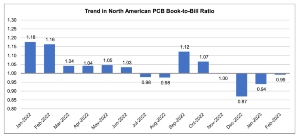
IPC announced the February 2023 findings from its North American Printed Circuit Board (PCB) Statistical Program. The book-to-bill ratio stands at 0.99.
Total North American PCB shipments in February 2023 were up 5.6 percent compared to the same month last year. Compared to the preceding month, February shipments were up 16.4 percent.
PCB bookings in February were up 1.5 percent compared to the same month last year. February bookings were up 7.8 percent compared to the preceding month.
“Shipments were strong in February and are tracking above 2021 levels for the year,” said Shawn DuBravac, IPC’s chief economist. “However, despite a strong February, order volume remains down through the first two months.”
Detailed Data Available
Companies that participate in IPC’s North American PCB Statistical Program have access to detailed findings on rigid PCB and flexible circuit sales and orders, including separate rigid and flex book-to-bill ratios, growth trends by product types and company size tiers, demand for prototypes, sales growth to military and medical markets, and other timely data.
Interpreting the Data
The book-to-bill ratios are calculated by dividing the value of orders booked over the past three months by the value of sales billed during the same period from companies in IPC’s survey sample. A ratio of more than 1.00 suggests that current demand is ahead of supply, which is a positive indicator for sales growth over the next three to twelve months. A ratio of less than 1.00 indicates the reverse.
Year-on-year and year-to-date growth rates provide the most meaningful view of industry growth. Month-to-month comparisons should be made with caution as they reflect seasonal effects and short-term volatility. Because bookings tend to be more volatile than shipments, changes in the book-to-bill ratios from month to month might not be significant unless a trend of more than three consecutive months is apparent. It is also important to consider changes in both bookings and shipments to understand what is driving changes in the book-to-bill ratio.
IPC’s monthly PCB industry statistics are based on data provided by a representative sample of both rigid PCB and flexible circuit manufacturers selling in the USA and Canada. IPC publishes the PCB book-to-bill ratio by the end of each month.
Share on:


Testimonial
"Our marketing partnership with I-Connect007 is already delivering. Just a day after our press release went live, we received a direct inquiry about our updated products!"
Rachael Temple - AlltematedSuggested Items
A.R.T. MD Recognized Among UK’s Top Women Business Leaders for 2025
11/24/2025 | A.R.T. Ltd.Debbie McDade, Managing Director of Advanced Rework Technology Ltd (A.R.T.), has been named one of the winners in the Influential Women in Business Awards 2025, an initiative recognising leadership and achievement across UK industry.
The Purity of Certification
11/19/2025 | Juan Balderrama, Global Electronics Association MexicoThe global context has changed dramatically. The United States has imposed tariffs on China and other countries with the goal of protecting its market and reducing dependence on distant supply chains. This measure has triggered a strategic realignment in manufacturing: Many companies are now seeking to establish operations closer to their main customer.
EIPC Technical Snapshot: Sustainability in Electronics Manufacturing
11/06/2025 | Pete Starkey, I-Connect007EIPC selected the highly topical issue of sustainability in electronics manufacturing for the 24th Technical Snapshot webinar on Oct. 29, with guest speakers Satoshi Konagai of Elephantech and Liisa Hakola of the VTT Technical Research Centre of Finland. The program was moderated by Kirsten Smit-Westenberg, executive director of EIPC, who also introduced each speaker.
Target Condition: Distribution of Power—Denounce the Ounce
11/05/2025 | Kelly Dack -- Column: Target ConditionHave you ever wondered why the PCB design segment uses ounces to describe copper thickness? There’s a story behind all of this—a story that’s old, dusty, and more than a little absurd. (Note that I didn’t add “Like many of us.”) Legend has it that back in the days of copper tinkers and roofing tradesmen, the standard was set when a craftsman hammered out a sheet of copper until it weighed one ounce, when its area conveniently matched the square of the king’s foot.
Life Is a Highway: A Family of 8 Turned the Entire U.S. Into a Learning and Working Environment
11/04/2025 | Steven Bowles, Lockheed MartinIt’s 6:45 a.m. in a modern A-frame cabin tucked into the misty edges of the Cascade Range in Arlington, Washington. I’ve just made a quick Nespresso, checked my calendar of virtual meetings, and verified the Airbnb’s Wi-Fi speed is holding steady. In the next room, my wife Lynsey corrals our six kids into breakfast while planning a day trip to Seattle’s Children’s Museum. By 7:30, I’m camera-ready in a makeshift office nook, leading a discussion on HDI PCB design for an IPC standards committee. After a busy day, our Bowles crew, ranging in age from 1 to 10 years old, is hands-on with activities and exhibits in the museum.