














 Dan’s Biz Bookshelf: ‘Abundance: How We Build a Better Future’
 Trouble in Your Tank: In Complex Systems, Design Rules Aren’t Optional
 It’s Only Common Sense: The Phone Is Still Your Competitive Advantage





A Conversation (and Day) with Joe Fjelstad, Part 2
May 5, 2015 | Barry Matties, I-Connect007Estimated reading time: 4 minutes
Part 2: The Future of Electronics, the Role of Software and (gasp) Liberalism vs. Conservatism!
Joe and I continued our discussion with the subject of the future of what’s to come for the electronics industry, which, according to Fjelstad, has a lot to do with where we’ve just been in our quest for lead-free manufacturing. He also offers his view on the natural order of the evolution of personal political persuasions.
Barry Matties: Joe, what do you see as the future of electronics?
Joe Fjelstad: That's a bit of a loaded question. I can safely say I believe it will be different. As you know, I personally see a compelling case for eliminating solder from the manufacturing process because, at least to me, it makes too much sense, not just economically and environmentally, but from a reliability perspective as well, though I will probably be dead before it happens. (laughs) Presently, we are still stuck in that paradigm where hardware is an inconvenience that is not all that important; it’s the software stuff that is really important. It's all about service and the apps. Some phones are “free” at present, but I think there will be an awakening at some point.
Matties: There has been a shift in that as we see more software companies entering the hardware space.
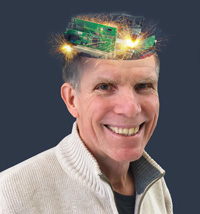
Fjelstad: Understood, but the way that they're driving the cost on those things is to sell the software. They want to sell the apps. They're all about the high-margin items. It's always been there. Hardware is just an unfortunate middleman. There may be an occasion in the future where we start plugging apps into ports in our heads to access our brain and those devices will be hardware as well as software. I don't think that scenario is all that crazy.
Matties: I don't mind being lead-free (laughs).
Fjelstad: Actually, to that point, because you have a medium that you're plugged into, you don't need to worry about it. But as far as the future goes, I believe supercapacitor technology will be a big game changer in electronics for energy storage. The other things that hold interest for me are futurist things like the photonic transistors. When they arrive it will create another big game changer for processing—low energy and speed of light performance. Meanwhile, I like the being work done at GreenArrays where they are now producing chips with up to 144 cores, that is, 144 complete computers with ROM and RAM, that operate in zero wait mode and use very little energy.
Multicore processors appear to have been the brainchild of Chuck Moore who was also the inventor of Forth programming language, which I understand from those more knowledgeable than me on the topic, is very elegant. The language was used on some of the earliest microprocessor chips. The new multicore chips are very tiny, high-performing and energy conservative, and those are features that are going to be critical going forward. It is interesting where we are today. One doesn't need a gigahertz or a multi-gigahertz processor to word process. It's just not necessary, though it's probably very important for things like voice recognition, such as Dragon NaturallySpeaking. No doubt, high-performance processors are very helpful there, but I suspect that multicore could play a role as well.
It is actually quite stunning where voice recognition technology is today. I've been using that through several generations and it just keeps on getting better. It still makes mistakes and it doesn't understand everything, but then, I suppose, it arguably doesn’t understand anything. It is sensing sounds to create words and put them together contextually, based on what it has seen over the life of its operation; thus, it has a certain learning quality to it.
Matties: I'm really enjoying this part of my job where I'm talking to people and hearing their stories, like we're doing today. It's really interesting to listen to the people in our industry and hear different viewpoints, especially when they are so contrasting.
Fjelstad: Clearly, the differing viewpoints we have are very interesting. I love all my friends in this industry, but oftentimes, they're not on the same page with a lot of things. One may still hold a great deal of affection for others, but it gets to the point with some topics where you can't understand each other on certain topics, because both are talking over a chasm and the message does not get across. I always worry when I hear about somebody who says they're a young conservative. God, that’s frightening.
Matties: Is it much different than an older conservative?
Fjelstad: The thing is, to be young and conservative is, I believe, the antithesis of the goal of nature for youth. It's actually the opposite. You should be radical when you're young; conservatism is for later in life because most folks generally become more conservative with age. Be crazy and wild while you're young and then you will be brought back. Nature will bring you back to center. If you are conservative when young, you are likely to become ossified by middle age. I suppose I have a different way of looking at things. There's so many times in my life I should have been dead and yet I'm still here. Must be for some reason, but I don't know what that is.
Matties: You don’t tend to become radical later.
Fjelstad: Yeah, it’s tough to become more liberal with age. While somewhat on the topic and if I can touch the “third rail” lightly, I worry about the intertwining of religion and politics. The founders were deists who believed in God but who saw the importance of separation of church and state. Granted, the nation was predominantly Christian, but the warring between Catholics and Protestants seen in Europe was not lost on them. The country held the two apart fairly well until the 1950s and McCarthy’s hunt for godless communists. I have no problems with any religion at all, but I believe it's very important to keep it separated from the government and politics. It is a slippery slope towards division of the populace and creation of intolerance for those of divergent views or beliefs. We see it happening in Iraq; I would hate to see it happen here. That does not have much to do with technology does it? Now I think I actually need to get back on the rails. (laughs)
Coming Wednesday: Part 3: Fjelstad describes his entry into electronics manufacturing, via Vietnam, and a French restaurant, and how his understanding of history, especially war, has shaped his world view. Also discussed: India, and the positive example they are setting for the rest of the world.
Click Here if you missed Part 1 and Click here to advance to Part 3
Share on:


Testimonial
"Our marketing partnership with I-Connect007 is already delivering. Just a day after our press release went live, we received a direct inquiry about our updated products!"
Rachael Temple - AlltematedSuggested Items
BGA Technology Expands Inspection Capabilities with Creative Electron TruView X-ray System
05/08/2026 | BGA TechnologyBGA Technology, a leading provider of advanced electronics testing and inspection services, has enhanced its inspection capabilities with the addition of a Creative Electron TruView™ Simplex X-ray system at its Holbrook, New York facility.
AQUANOX A4727 and A4625 Lead KYZEN Offerings at SMTA Oregon Expo and Tech Forum
05/06/2026 | KYZENKYZEN, the global leader in innovative environmentally responsible cleaning chemistries, will exhibit at the SMTA Oregon Expo and Tech Forum scheduled to take place Thursday, May 19 at the Wingspan Event and Conference Center in Hillsboro, Oregon.
Connect the Dots: Designing for the Future of Manufacturing Reality—Surface Finish
05/07/2026 | Matt Stevenson -- Column: Connect the DotsWhen designing the complex boards that many electronic devices require to operate, designers should consider manufacturability at every step. This is my last article focused on designing for the always-evolving manufacturing reality. Choosing the right surface finish has always been important. If you are creating intricate designs with a wide variety of components, like for an ultra-high density interconnect (UHDI) board, surface finish is a critical last step.
Indium to Showcase High-Performance AI Application Solutions at SEMICON SEA 2026
05/01/2026 | Indium CorporationAs a leading provider of advanced materials solutions for today’s demanding AI applications, Indium Corporation® will feature its high-reliability product portfolio at SEMICON SEA 2026, May 5-7, in Kuala Lumpur, Malaysia.
ACCM Unveils Negative and Near-zero CTE Materials for Large-Format AI Chips
04/21/2026 | Advanced Chip and Circuit MaterialsAdvanced Chip and Circuit Materials, Inc. (ACCM) has launched two new materials: Celeritas HM50, with a negative coefficient of thermal expansion (CTE) of -8 ppm/°C to offset the positive CTE and expansion of copper with temperature on circuit boards, and Celeritas HM001, with near-zero CTE and the low-loss performance needed for high-speed signal layers to 224 Gb/s and faster in artificial intelligence (AI) circuits.