















 American Made Advocacy: Rebuilding America’s Military Stockpiles Begins With Microelectronics
 The Right Approach: The End of an Era—DoD Proposes MIL-PRF-31032 Cancellation
 Defense Speak Interpreted: Hypersonics Report Back After Six Years of Silence





New Galaxy-hunting Sky Camera Sees Redder Better
February 3, 2016 | LBLEstimated reading time: 5 minutes
A newly upgraded camera that incorporates light sensors developed at the U.S. Department of Energy’s Lawrence Berkeley National Laboratory (Berkeley Lab) is now one of the best cameras on the planet for studying outer space at red wavelengths that are too red for the human eye to see.
Very distant astronomical objects appear much redder when observed on Earth due to an effect known as redshift, so this sensitivity to red light enables the camera to detect objects many billions of light years away.
The camera has begun its two-year mission to quickly survey the sky, amassing images of hundreds of millions of galaxies and stars.
Star trails take shape around Kitt Peak National Observatory in this long-exposure image. The 4-meter Mayall telescope building, at right, now houses Mosaic-3, a new infrared camera built by a collaboration that includes Berkeley Lab scientists. (Photo credit: P. Marenfeld and NOAO/AURA/NSF)
The rebuilt camera, dubbed Mosaic-3, was installed in October on the 4-meter Mayall telescope at Kitt Peak National Observatory near Tucson, Ariz. It will survey the northern sky at infrared wavelengths from 850 nanometers to 1 micron, a range known as the “z-band.”
Mosaic-3 will capture images nearly twice as fast as its predecessor camera, and can see galaxies 10 times fainter than those detected in a previous survey called the Sloan Digital Sky Survey.
Mosaic-3 is the product of a small collaboration of scientists and engineers at Berkeley Lab, Yale University, and the National Optical Astronomy Observatory (NOAO).
It will help to scout out galaxies that can be targeted for further observations by DESI, the Dark Energy Spectroscopic Instrument, which is scheduled to be installed on the Mayall telescope in 2018.
A view of the Berkeley Lab-developed light sensors, known as charge-coupled devices or CCDs, that allow the Mosaic-3 camera to capture infrared light from distant galaxies. (Photo credit: Tom Hurteau, Yale University Physics Department)
DESI, which will be built by a Berkeley Lab-led collaboration, will produce a 3-D map of the universe out to a distance of 12 billion light years. By measuring the velocities of millions of galaxies and extremely bright and distant objects known as quasars, DESI will chronicle the expansion history of the universe to unprecedented precision. It will yield a better understanding of “dark energy,” a mysterious form of energy that is causing this universal expansion to accelerate.
Mosaic-3’s primary mission is to carry out a survey of roughly one-eighth of the sky (5,500 square degrees). This survey, known as the Mayall z-Band Legacy Survey (MzLS), will span about 220 nights of observations this year and next, and all of the camera’s data will be immediately available to the public. During the remaining nights, Mosaic-3 will be available to astronomers for other research.
The z-band survey is just one layer in the galaxy survey that is locating targets for DESI. Data from this survey are being combined with data from other telescopes to produce images of galaxies in many colors, and the combined data will be publicly released twice per year on the Legacy Survey website.
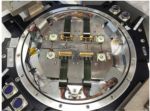
The Mosaic-3 camera is an upgrade that brings new cutting-edge sensors developed at Berkeley Lab to an existing, decade-old camera at the Mayall Telescope. The cryostat (a device used to maintain a supercool temperature) from this camera was refurbished to incorporate the new light sensors, and the electronics were replaced.
A view of the focal plate for the Mosaic-3 camera. (Photo credit: Tom Hurteau, Yale University Physics Department)
“We rebuilt the whole camera,” said Charles Baltay, a Yale physics professor who oversaw the university’s work on Mosaic-3. “We started in early February and delivered it in August—we had to hustle. At first, people said we couldn’t do it this fast.”
He added, “Mosaic-3 can measure the same object in half the time compared to its predecessor. It allows us to do the target-selection survey in time—it moves it from impossible to comfortable.”
Page 1 of 2
Share on:


Testimonial
"In a year when every marketing dollar mattered, I chose to keep I-Connect007 in our 2025 plan. Their commitment to high-quality, insightful content aligns with Koh Young’s values and helps readers navigate a changing industry. "
Brent Fischthal - Koh YoungSuggested Items
Boeing, U.S. Navy Achieve Successful MQ-25A Test Flight
04/28/2026 | BoeingBoeing and the U.S. Navy have successfully completed the first test flight of an operational MQ-25A Stingray™.
Bellatrix Lands $20M Pre-Series B for Global Expansion
04/02/2026 | BellatrixBellatrix Aerospace, a leading In-Space Mobility company from India with a presence in the USA, announced that it has closed a US$20 million Pre-Series B growth round led by Cactus Partners, marking a significant milestone as the company accelerates the commercialization and delivery of its propulsion systems.
Akrometrix Discusses AI Chip Board Demands
03/27/2026 | Real Time with... APEX EXPOPaul Handler of Akrometrix discusses the evolving demands in PCB fabrication, particularly the surge in large-format, room-temperature boards for AI chips. He highlights the critical need for inline, real-time testing of heavy, high-value circuit boards and Akrometrix's strategic shift towards integrated Industry 4.0 solutions. Handler also highlights the engineering challenges and the company's positive outlook for industry growth.
DARPA-developed Autonomous Helicopter Technology Transitions to U.S. Army
03/23/2026 | DARPADARPA’s vision to reimagine the role of human pilots and revolutionize military aviation has culminated in the transition of a DARPA-developed autonomous flight system to the U.S. Army.
Marshall Aerospace Boosts UK Drone Sector with Five Government-backed Assessments
03/23/2026 | MarshallMarshall Aerospace is strengthening its leadership in the UK’s fast-growing unmanned aircraft systems (UAS) sector after securing five separate SAIL Mark assessment projects funded by Innovate UK and the Department for Transport.