













 Dan’s Biz Bookshelf: ‘Abundance: How We Build a Better Future’
 Trouble in Your Tank: In Complex Systems, Design Rules Aren’t Optional
 It’s Only Common Sense: The Phone Is Still Your Competitive Advantage





New Fabric-Based Sensor Overcomes Loose Clothing Obstacle
November 13, 2018 | UMass AmherstEstimated reading time: 2 minutes
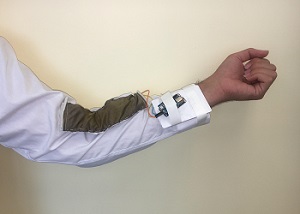
In a paper presented at SenSys 2018, the 16th ACM Conference on Embedded Networked Sensor Systems November 4-7 in Shenzhen, China, a team of UMass Amherst scientists introduced Tribexor, a fabric-based triboelectric joint sensing system that can be integrated with loose-fitting clothing to sense a variety of joint movements such as flexion, extension and velocity of joint movement.
The team included electrical and computer engineering graduate students Ali Kiaghadi and Morgan Baima, with senior computer science researcher Jeremy Gummeson and professors Trisha Andrew, chemistry, and Deepak Ganesan, computer science,
As they point out, in the field of wearable devices one area expected to grow dramatically in the next decade issmart clothing – shirts, pants, bandages and caps fitted with instruments to perform health monitoring functions, for example. Compared to devices like smart watches, smart garments can become part of one’s daily routine and measure a much larger set of body locations.
But a fundamental problem for smart garments is whether they can obtain useful signals from loosely worn clothing, Ganesan explains. Many sensors, like inertial sensors and electromyography require a tight fit to reduce motion artifacts and obtain a meaningful signal. But tight clothing is uncomfortable to wear and not appropriate in many applications such as elder care and patient care, he adds.
For their new device, the researchers used functionalized triboelectric fabric developed in Andrew’s materials chemistry lab. The fabric is comprised of layers that transfer surface charge from one layer to another and generate a voltage or current when compressed, tugged or twisted due to joint motion. This translates movement into an electrical signal and extract useful information from loosely worn smart textiles.
Ganesan says, “Normally, loose fitting clothing would be considered a problem because that means we have to deal with a significant amount of noise, which is already a problem for relatively tight fitting devices like fitness bands.” But the Tribexor device turns this limitation into an advantage, he notes, because loose-fitting clothing can fold, compress and twist more.
The authors report that Tribexor has 95 percent accuracy for detecting elbow and knee flexion and extension movements and 85 percent accuracy for estimating angular velocity of the elbow and knee joints. It also accurately detects a variety of activities of daily living allowing it to be used instead of a smartwatch to monitor activity.
The researchers expect such advances to expand the usefulness of fabric-based sensors. Andrew says, “This technology can be particularly useful for monitoring elderly individuals. Current generation wearables, like smartwatches, are not ideal for this population since elderly individuals often forget to consistently wear or are resistant to wearing additional devices, whereas clothing is already a normal part of their daily routine.”
The authors are collaborating with the Institute of Applied Life Sciences (IALS) with the goal of translating life science research into products that improve human health. Peter Reinhart, IALS director, says, “This is a very exciting new technology which can enable monitoring of many limbs and joints to measure gait imbalance, sleep disturbances and changes in motor activity and posture. It is also wonderful to see such interdisciplinary collaboration generate exciting new ideas that can impact the future of health care.”
Share on:



Subscribe
Stay ahead of the technologies shaping the future of electronics with our latest newsletter, Advanced Electronics Packaging Digest. Get expert insights on advanced packaging, materials, and system-level innovation, delivered straight to your inbox.
Subscribe now to stay informed, competitive, and connected.
Suggested Items
STMicroelectronics Enables Always-On Vision with Ultralow-Power Image Sensors
05/01/2026 | STMicroelectronicsSTMicroelectronics, a global semiconductor leader serving customers across the spectrum of electronics applications, introduces a new generation of ultralow-power global-shutter image sensors that deliver high-quality, always-on vision to compact devices operating on batteries or harvested energy.
Alpha, Omega Semiconductor Launches SmartClamp DrMOS for AI Servers and GPUs
05/01/2026 | AlphaAlpha and Omega Semiconductor Limited (AOS) a designer, developer, and global supplier of a broad range of discrete power devices, wide bandgap power devices, power management ICs, and modules, announced the launch of the SmartClamp™ family of protected DrMOS.
UHDI Fundamentals– Applications, Challenges, and the Future of Flex–Packaging Integration, Part 2
04/16/2026 | Anaya Vardya, American Standard CircuitsIn the second of this two-part series, Anaya Vardya of American Standard Circuits examines applications, challenges, manufacturing considerations, and future trends emerging from the convergence of flexible printed circuit boards and advanced semiconductor packaging. Applications driving the convergence include consumer electronics, automotive systems, medical, wearables, aerospace and more.
Huawei, LG Electronics and Nokia Named as Founder Licensors of New Sisvel POS Pool
04/01/2026 | BUSINESS WIREThree world-class innovators are the founder licensors of the new Point of Sale (POS) patent pool, covering 2G to 5G technology, which Sisvel has launched today.
Asia/Pacific PC Market Up 11.6% in 2025; Supply and Pricing Challenges Loom for 2026
03/24/2026 | IDCThe Asia/Pacific (including Japan and China) traditional PC market (desktops, notebooks, and workstations) grew by 11.6% in 2025 to 106.6 million units, according to the International Data Corporation (IDC) Worldwide Quarterly Personal Computing Devices Tracker, Q4 2025.