















 Connect the Dots: Designing for the Future of Manufacturing Reality—Surface Finish
 The Pulse: Caught in the Crosshatch—A Cautionary Tale of Detective Work
 Fresh PCB Concepts: Designing PCBs for Harsh Environments—Reliability Is Engineered Upstream





Ventec Thermal Management Book Excerpt: Chapter 1
September 5, 2022 | Didier Mauve and Robert Art, VentecEstimated reading time: 2 minutes
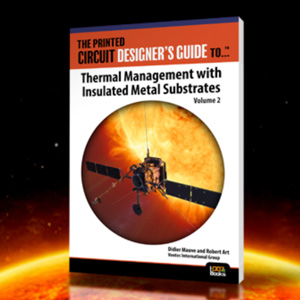
The Printed Circuit Designer's Guide to...Thermal Management with Insulated Metal Substrates, Vol. 2
Chapter 1: High Emissivity
Regarding basic principles of thermal dissipation there are three ways of dissipating energy:
- Conduction
- Convection
- Radiation
The integrated metal substrate (IMS) printed circuit boards rely predominantly on heat conduction all the way through the different layers of the substrates from a hot point (the base of the component) to a cold point (the furthest surface of the metal base) and, usually, thereafter, through a dissipator. Ideally, the thermal engineering of the package, soldered connection(s) to the substrate, dielectric layer, IMS metal base, and dissipator should conduct heat as effectively as possible away from the die and into the ambient. That is, they should have the highest possible thermal conductivity (or low thermal resistance, the one being the inverse of the other). However, various other properties are needed, and the entire system cannot be designed solely around thermal performance. The different elements of the “stackup” (noting that inside the package there is typically some combination of metallic parts such as bondwires and/or leadframe, ceramics or plastics, FR4 or similar substrate in the case of a system-in-package device or high-performance MPU, and adhesives) can be modeled as a series of dissimilar thermal resistances.
Ultimately, thermal energy conducted into the metal base is transferred into the ambient by radiation. The effectiveness of this transfer is influenced by factors such as the emissivity of the surface and the radiating area in contact with the surrounding air. The emissivity is dependent on the material as well as the surface finish (basic physics tells us that a matte black surface radiates heat more effectively than a shiny surface–and also absorbs heat radiated from nearby sources more effectively than a polished surface).
After being transferred into the surrounding air by radiation, the heat dissipates throughout the atmosphere by a process of convection.
To download the 2nd volume of this I-Connect007 eBook, click here.
To download the 1st volume of The Printed Circuit Designer's Guide to...Thermal Management with Insulated Metal Substrates, click here.
Share on:


Testimonial
"In a year when every marketing dollar mattered, I chose to keep I-Connect007 in our 2025 plan. Their commitment to high-quality, insightful content aligns with Koh Young’s values and helps readers navigate a changing industry. "
Brent Fischthal - Koh YoungSuggested Items
Connect the Dots: Designing for the Future of Manufacturing Reality—Surface Finish
05/07/2026 | Matt Stevenson -- Column: Connect the DotsWhen designing the complex boards that many electronic devices require to operate, designers should consider manufacturability at every step. This is my last article focused on designing for the always-evolving manufacturing reality. Choosing the right surface finish has always been important. If you are creating intricate designs with a wide variety of components, like for an ultra-high density interconnect (UHDI) board, surface finish is a critical last step.
Elsyca Acquires Hivelix to Strengthen Simulation Platform for Electrochemical Surface Engineering
04/03/2026 | ElsycaElsyca, a global pioneer in computer-aided engineering (CAE) simulation for electrochemical processes and surface finishing, announces the acquisition of Hivelix, a specialist in advanced surface treatment simulation with strong expertise in multiphysics modelling and AI-assisted process optimisation.
Connect the Dots: Designing for the Future of Manufacturing Reality—Solder Mask and Legend
04/09/2026 | Matt Stevenson -- Column: Connect the DotsPCBs seem to be getting more complex by the day, so it is important for designers to keep educating themselves about the realities of manufacturing increasingly intricate boards. Last month’s column highlighted design considerations for the strip-etch-strip process and how manufacturers approach that phase of production. Now that we have a functioning board, we must protect the PCB from environmental hazards and document the circuit components. This article will detail the solder mask and legend process and offer best practices for designers to ensure a high-quality result.
Take the Mic: Photo Chemical Systems: 50 Years Strong
04/03/2026 | Real Time with... APEX EXPOPhoto Chemical Systems is celebrating 50 years in the bare board PCB market. David Graves and Jason Averette discuss how they've expanded into assembly, leveraging strong relationships and a customer-centric approach to navigate supply chain challenges. With innovative solutions and future growth strategies, including AI integration and new market ventures, Photo Chemical Systems continues enduring success.
Bold Laser Automation Introduces Precision Laser Cleaning System for Advanced Manufacturing
03/27/2026 | PRNewswireBold Laser Automation, Inc. has introduced the LPCl1820UV Laser Precision Cleaning System, a Class 1, industrial laser platform engineered for high-precision surface cleaning and thin-film removal in demanding manufacturing environments.