

















 Elementary, Mr. Watson: Waking Up Europe's PCB Giants
 Connect the Dots: Getting the PCB Quote Right
 Powering the Future: What Engineers Get Wrong About Designing for Reliability





Aeva Inc said it has shrunk the main components of its “lidar” self-driving car sensor onto a single chip, a move it expects to dramatically lower the price of a sensor widely considered a bottleneck in the mass production of autonomous vehicles.
The company, founded by ex-Apple Inc engineers Soroush Salehian and Mina Rezk, on Wednesday also said it has taken investment from Porsche Automobil Holding SE (PSHG_p.DE), the majority-voting shareholder of Volkswagen AG (VOWG_p.DE).
Lidar sensors generate a 3D map of the world around the car. In addition to the map, Aeva’s sensor detects the velocity of objects in a car’s surroundings, which could help cars determine whether an object hundreds of meters down the road is a tree or a pedestrian.
The investment Wednesday, whose size was not disclosed, follows a previous deal in April with the Autonomous Intelligent Driving unit of Audi - another Volkswagen marque - which plans to use the startup’s lidar sensor on its so-called “e-tron” development fleet vehicles in Munich, Germany.
Aeva’s sensor uses a different technology than other lidar units currently being tested on the road, which have spinning parts and send out powerful laser bursts. Aeva’s sensor has no moving parts and uses a less powerful continuous wave. That allowed the company to put the most important parts onto a chip about the size of a U.S. quarter that can be made in the same factories that currently make data center networking chips.
“We have not used any exotic components,” Salehian said in an interview at Aeva’s Mountain View, California headquarters.
Aeva believes it can sell sensors for less than $500 that can see 300 meters (984 feet) ahead. Early next year, Aeva plans to release a unit that is half the size of its predecessor but with a field of view which is twice as wide at 120 degrees. It aims to release a smaller, final production version by 2022.
The falling cost and size of the units captured Volkswagen’s attention and prompted it to partner more deeply with the startup, said Alex Hitzinger, senior vice president of autonomous driving at Volkswagen and chief executive of subsidiary Volkswagen Autonomy. Current lidar systems can cost tens of thousands of dollars, a cost automakers say must come down to a few hundred dollars.
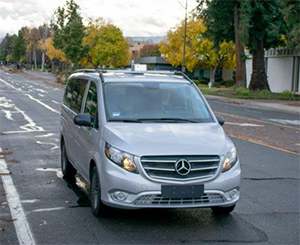
Hitzinger said Volkswagen is looking into using Aeva’s sensor on the I.D. BUZZ, an electric reboot of its iconic microbus that is scheduled to launch in 2022 or 2023.
“Cost is very, very important,” Hitzinger said in an interview. “These things are extremely expensive at the moment, especially the lidar sensors. We need to get to a technology that is scalable.”


