














 Knocking Down the Bone Pile: Hot Air vs. Infrared PCB Rework
 Nolan’s Notes: Why Mexico’s Time Has Come
 Standard of Excellence: ‘Quality’ Is Your Company's Greatest Competitive Advantage





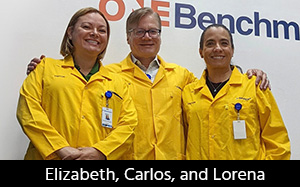
With plants in Tijuana and Guadalajara, Mexico, that staff more than 3,000 employees, Benchmark Electronics has a continual need for training and certification to stay competitive. Through a unique partnership with IPC, the company was able to train nearly 100 operators and engineers through a pilot program that saved them money and elevated the knowledge base of their workforce.
In this interview, Elizabeth Magana, a regional human resources director for Benchmark, Lorena Villanueva, IPC director of Mexico, and Carlos Plaza, IPC senior director of education development, detail the pilot program and how it serves as an example of training success in electronics manufacturing.
Can you tell us about Benchmark’s presence in Mexico?
Elizabeth Magana: Benchmark has been in Mexico for over 20 years. We manufacture or assemble high-reliability products for large-scale integration, system build to order, PCB assemblies, cable harnesses, and more. We serve key market sectors including complex industrial, defense, and commercial aerospace.
What does your typical onboarding effort look like? How are you getting new hires up to speed?
Elizabeth: We have a robust training program for each of our sites. We have a training team onsite that focuses not only on the production training, but also on company policies, procedures, values, etc.
You were introduced to IPC’s training programs through Lisa Weeks, a former IPC board member and Benchmark executive. What intrigued you to pursue it further?
Elizabeth: In discussing this with our regional leader, we knew that we had some areas of opportunity when it came to knowing all that IPC has to offer, and we saw that there were two areas where IPC could be beneficial to us: the engineering group and direct labor, meaning those who assemble the products.
Often, we find there is confusion on even how to assemble the products to IPC specifications, and there are many conversations that take place between quality engineering and manufacturing, as well as with the assembly teams.
We determined that we would run 44 operators through Electronics Assembly for Operators (EAO), and 25 engineers through Electronics Assembly for Engineers (EAE). We let each site determine who those people would be. Because it’s a pilot program, we didn’t focus on things like seniority or experience, but rather on who would most benefit from the IPC training. Both groups went through the same training no matter their level of experience.
Lorena, how were the courses designed and offered?
Lorena Villanueva: These courses were designed and approved by the industry. EAO is offered fully in Spanish, which was huge for Benchmark because it’s very hard to find operators who are bilingual. The classes are self-paced and online. Benchmark provided the computers and gave the employees the opportunity to go through one or two modules at a time.
Continue reading this interview in the summer 2023 issue of IPC Community.


