












-
- News
- Books
Featured Books
- I-Connect007 Magazine
Latest Issues
Current Issue
Beyond the Rulebook
What happens when the rule book is no longer useful, or worse, was never written in the first place? In today’s fast-moving electronics landscape, we’re increasingly asked to design and build what has no precedent, no proven path, and no tidy checklist to follow. This is where “Design for Invention” begins.
March Madness
From the growing role of AI in design tools to the challenge of managing cumulative tolerances, these articles in this issue examine the technical details, design choices, and manufacturing considerations that determine whether a board works as intended.
Looking Forward to APEX EXPO 2026
I-Connect007 Magazine previews APEX EXPO 2026, covering everything from the show floor to the technical conference. For PCB designers, we move past the dreaded auto-router and spotlight AI design tools that actually matter.
- Articles
- Columns
- Links
- Media kit
||| MENU - I-Connect007 Magazine
An Electrifying Improvement in Copper Conductivity
December 28, 2023 | PNNLEstimated reading time: 1 minute
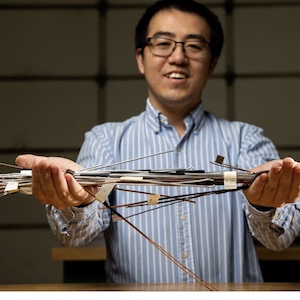
A common carbon compound is enabling remarkable performance enhancements when mixed in just the right proportion with copper to make electrical wires. It’s a phenomenon that defies conventional wisdom about how metals conduct electricity. The findings, reported December 2023 in the journal Materials & Design, could lead to more efficient electricity distribution to homes and businesses, as well as more efficient motors to power electric vehicles and industrial equipment. The team has applied for a patent for the work, which was supported by the Department of Energy (DOE) Advanced Materials and Manufacturing Technologies Office.
Materials scientist Keerti Kappagantula and her colleagues at DOE’s Pacific Northwest National Laboratory discovered that graphene, single layers of the same graphite found in pencils, can enhance an important property of metals called the temperature coefficient of resistance. This property explains why metal wires get hot when electric current runs through them. Researchers want to reduce this resistance while enhancing a metal’s ability to conduct electricity. For several years they have been asking whether metal conductivity be increased, especially at high temperatures, by adding other materials to it. And if yes, can these composites be viable at commercial scale?
Now, they’ve demonstrated they can do just that, using a PNNL-patented advanced manufacturing platform called ShAPE™. When the research team added 18 parts per million of graphene to electrical-grade copper, the temperature coefficient of resistance decreased by 11 percent without decreasing electrical conductivity at room temperature. This is relevant for the manufacturing of electric vehicle motors, where an 11 percent increase in electrical conductivity of copper wire winding translates into 1 percent gain in motor efficiency.
“This discovery runs counter to what’s generally known about the behavior of metals as conductors,” said Kappagantula. “Typically, introducing additives into a metal increases its temperature coefficient of resistance, meaning they heat up faster at the same current levels compared to pure metals. We are describing a new and exciting property of this metal composite where we observe enhanced conductivity in a manufactured copper wire.”
Testimonial
"In a year when every marketing dollar mattered, I chose to keep I-Connect007 in our 2025 plan. Their commitment to high-quality, insightful content aligns with Koh Young’s values and helps readers navigate a changing industry. "
Brent Fischthal - Koh YoungSuggested Items
Indium Corporation Announces Strategic Agreement for Domestic Critical Metals Recovery
04/06/2026 | Indium CorporationIndium Corporation®, an industry leader in innovative materials solutions for semiconductor packaging and electronics assembly, announced that it has executed a long-term offtake framework agreement with Flash Metals USA Inc., a wholly owned subsidiary of Metallium Limited (MTM), for the supply of critical metals recovered using Metallium’s Flash Joule Heating technology.
China Halts Gallium, Germanium, Antimony Ban for US, But Licensing Still Required
11/10/2025 | I-Connect007 Editorial TeamChina has suspended a ban on exports of gallium, germanium, and antimony to the United States, Reuters reported. However, China’s commerce ministry stated on Nov. 9 that Beijing’s licenses are still required for wider export restrictions on the metals.
Coherent Evaluates Strategic Alternatives for Its Advanced Lithium-Ion Battery Recycling Technology
12/13/2024 | Globe NewswireCoherent Corp., a global leader in materials, networking, and lasers, today announced that as a result of an ongoing strategic portfolio assessment, the company will evaluate strategic alternatives for its Streamlined Hydrometallurgical Advanced Recycling Process (SHARP™) technology to efficiently recover and recycle critical metals from lithium-ion batteries (LiBs).
Exploring Innovation Through Alternate Metals and Sputtering
11/11/2024 | Marcy LaRont, I-Connect007Dr. Evelyne Parmentier has a PhD in physical chemistry from ETH Zurich. She was born in Luxembourg and is now a proud resident of Switzerland, where she has been part of Dyconex’s R&D engineering team for the past two years. Evelyne gave a presentation at the EIPC Summer Conference titled “Functionalization of Printed Circuit Boards Through Introducing Alternate Metals Through Sputtered Layers,” where she asked her audience, “If there are 93 metals in the periodic table, why are we not using more of them?”
Marcy’s Musings: Destination Metallization
10/17/2024 | Marcy LaRont -- Column: Marcy's MusingsTo reach your intended destination, you must have some form of pathway or route upon which to travel. It is much the same with the metallized traces and features on a printed circuit board. They are how electrical signals and power are carried from one point to another in an electronic device. Copper is the most prevalent metal conductor, but other metals are also used to a lesser degree, including gold, silver, tin, and palladium.