











-
-
News
News Highlights
- Books
Featured Books
- smt007 Magazine
Latest Issues
Current Issue
Spotlight on North America
A North America spotlight exploring tariffs, reshoring, AI demand, and supply chain challenges. Plus, insights on cybersecurity, workforce development, and the evolving role of U.S. electronics manufacturing.
Wire Harness Solutions
Explore what’s shaping wire harness manufacturing, and how new solutions are helping companies streamline operations and better support EMS providers. Take a closer look at what’s driving the shift.
Spotlight on Europe
As Europe’s defense priorities grow and supply chains are reassessed, industry and policymakers are pushing to rebuild regional capability. This issue explores how Europe is reshaping its electronics ecosystem for a more resilient future.
- Articles
- Columns
- Links
- Media kit
||| MENU - smt007 Magazine
AMOLED Panels Become Mainstream Display for Smartphones, with Shipments Set to Grow by Nearly 25% in 2024
September 6, 2024 | TrendForceEstimated reading time: 2 minutes
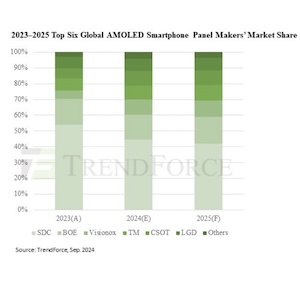
TrendForce’s latest projections show global shipments of AMOLED smartphone panels are anticipated to surpass 840 million units in 2024, reflecting a remarkable growth of almost 25% from 2023. With leading smartphone manufacturers increasingly embracing AMOLED technology, shipments are predicted to surpass 870 million units in 2025, representing a YoY increase of 3.2%.
Traditionally, Korean panel makers have dominated the AMOLED panel supply chain. However, in recent years, Chinese suppliers have ramped up their production of flexible AMOLED panels, ensuring a consistent supply to cater to surging market demand. Additionally, these Chinese companies have been forging partnerships with smartphone brands, which has led to a notable increase in AMOLED panel usage in smartphones, rising from 51% in 2023 to 56.9% in 2024. TrendForce posits this penetration rate is expected to grow by 2% to 3% each year—potentially reaching 68% by 2028—thereby establishing AMOLED panels as the standard display in the smartphone industry.
Korean panel makers mainly cater to Apple and Samsung, with their shipments to other brands declining annually, primarily offering limited quantities of rigid AMOLED panels. On the other hand, Chinese panel makers have experienced a consistent rise in AMOLED panel shipments. BOE has emerged as the top supplier of AMOLED smartphone panels in China, with projections indicating shipments will reach approximately 130 million units this year.
Alongside strong partnerships with local smartphone brands, BOE has been progressively increasing its shipments to Apple, having successfully passed the validation process for the upcoming iPhone 16 series in 2024 and is gearing up for mass production as planned. This achievement highlights that after years of development, BOE's products and technology are slowly earning recognition from major international brands like Apple, potentially opening doors for greater inclusion in Apple's future offerings.
TrendForce points out that other manufacturers of AMOLED smartphone panels are experiencing swift growth. Thanks to robust sales of Huawei's latest models in 2024, Visionox is projected to achieve shipments of 80 million units. Furthermore, both TIANMA and CSOT have begun to ramp up their AMOLED smartphone panel shipments this year, with a strong possibility of exceeding their past records.
It is anticipated that Chinese panel makers will represent 47.9% of global AMOLED smartphone panel shipments in 2024. By 2025, their total shipments are predicted to exceed those of their Korean counterparts, achieving a projected global market share of 50.2%.
Testimonial
"The I-Connect007 team is outstanding—kind, responsive, and a true marketing partner. Their design team created fresh, eye-catching ads, and their editorial support polished our content to let our brand shine. Thank you all! "
Sweeney Ng - CEE PCBSuggested Items
I-Connect007 Editor’s Choice: Five Must-Reads for the Week
05/08/2026 | Marcy LaRont, I-Connect007This week, I’ve selected some outstanding interviews that you’ll want to take note of. First, is a roundtable discussion featuring three dynamic industry cybersecurity experts. Please watch this important discussion that affects us all. Following that, I spotlight the IPC-2581 Consortium, which explains why IPC-2581 is the standard to replace Gerber data for manufacturing. Next, I am including my interview with PCBAA and AAM, who collaborated to release a short documentary on U.S. PCB manufacturing.
A Necessary Shift From Gerber to IPC-2581
05/07/2026 | Tracy Riggan, Global Electronics AssociationIPC-2581 is an open, vendor-neutral data exchange standard developed by the Global Electronics Association to streamline the exchange of PCB design information across fabrication, assembly, and test. It replaces multiple legacy formats—including industry standards, Gerber, and ODB++—with a single, comprehensive, XML-based dataset that captures all manufacturing details.
ViaSat-3 F3 Satellite Successfully Launches from Kennedy Space Center
05/04/2026 | BoeingBoeing mission controllers confirmed that the ViaSat-3 F3 (VS-3 F3) satellite is healthy in orbit following its successful launch aboard a SpaceX Falcon Heavy rocket at 10:13 a.m. ET from Kennedy Space Center (KSC) in Florida.
Microchip Expands Post-Quantum Root of Trust Controllers
04/29/2026 | MicrochipAs the industry embarks on the transition to post‑quantum cryptography (PQC), Microchip Technology is expanding its portfolio of Trust Shield, PQC‑ready devices with the TS1800 Platform Root of Trust controller and the TS50x secure boot controller.
Is China Plus One Still Happening in the PCB Industry?
04/28/2026 | Manfred Huschka, Manfred Huschka Management Consulting (Shenzhen) Ltd.For much of the past five years, China Plus One has been shorthand for supply-chain diversification: reducing dependency on mainland China by adding manufacturing capacity elsewhere in Asia. In the PCB industry, however, in early 2026, it is more nuanced. It looks less like a clean geographic shift and more like a layered, capital-intensive rebalancing of global capacity, one that still leaves China deeply embedded at the center.