














 The Fearless Connector: Why I Chose the Hard Road
 The Clean Truth: The Clean Truth About No-Clean Flux
 Global Sourcing Spotlight: Beyond China Plus One—Building a Truly Global Supply Network





TrendForce’s latest findings reveal that global smartphone panel shipments reached 2.157 billion units in 2024, marking an 11.4% YoY increase—the highest in recent years. This growth is driven by rising sales of new smartphone models, alongside increasing demand for second-hand and refurbished devices.
However, in 2025, as demand for new phones stabilizes and the second-hand market plateaus or slightly declines, global smartphone panel shipments are expected to dip by 3.2%, totaling 2.093 billion units.
BOE retained its leading position among the top five smartphone panel makers with 613 million units shipped in 2024, and shipments are anticipated to grow 2.7% to 630 million units in 2025.
Samsung Display (SDC) ranked second, buoyed by robust demand for AMOLED panels from Apple and its own smartphone lineup, with 378 million units shipped in 2024. However, with Apple expected to diversify its supplier base in 2025, SDC’s shipments could see a slight decline of 3.5%, reaching 365 million units.
HKC cemented its third-place position following rapid growth in a-Si LCD shipments, achieving 228 million units in 2024. Leveraging the cost advantages of its G8.6 production line, HKC anticipates a slight uptick in 2025 shipments to 230 million units (+0.7%), though competition from CSOT may apply pressure.
CSOT saw significant growth, closely collaborating with Xiaomi, which boosted its 2024 shipments to 215 million units, an impressive 83.2% YoY increase. This momentum is expected to continue into 2025, with shipments reaching 223 million units.
Tianma rounds out the top five, shipping 158 million units in 2024. Although declining demand for LTPS LCD panels poses a challenge, increasing market interest in AMOLED is expected to drive a 10% increase in Tianma’s 2025 shipments.
TrendForce highlights that demand for AMOLED panels remains strong in 2024, propelling shipment growth across major panel makers—a trend likely to continue into 2025. Conversely, demand for LTPS LCD panels, commonly used in mid-to-low-end smartphones, is gradually weakening, posing significant challenges for suppliers specializing in this technology.
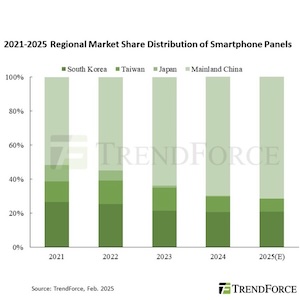
The rapid expansion of HKC and CSOT has led to a shrinking market share for Taiwanese a-Si LCD suppliers. Japanese panel makers have steadily withdrawn from the smartphone market, further reducing their share. Meanwhile, South Korean manufacturers continue to leverage their advanced flexible AMOLED technology to maintain dominance in the high-end segment, with a 20-21% market share in 2024.
Chinese manufacturers, driven by growing demand for both mid-to-high-end AMOLED and entry-level a-Si LCD panels, have aggressively expanded their market presence. In 2024, their combined market share is projected to reach 69.8% and may exceed 70% in 2025, solidifying their crucial role in the global smartphone supply chain.


