













 Defense Speak Interpreted: Will Defense Become a Totally New Supplier for Drone Electronics?
 The Right Approach: The End of an Era—DoD Proposes MIL-PRF-31032 Cancellation





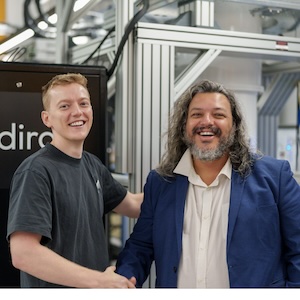
Diraq has partnered with new venture Iceberg Quantum to extract early value from its quantum computers.
Diraq has a clear line of sight towards delivering quantum computers that are utility scale, the point at which commercial value exceeds operational cost. This journey is driven by more than two decades of deep technical expertise in silicon ‘quantum dot’ technology, and it is being accelerated by Diraq’s strong partnerships across the quantum-computing stack.
The most recent addition to Diraq’s network is Iceberg Quantum, a company that will provide crucial expertise in a class of error-correction techniques called quantum low-density parity-check (qLDPC) codes.
Diraq plans to use a well-tested strategy known as the surface code to correct the errors that arise from the fragile nature of quantum information. But this code requires around 1,000 quantum bits (qubits) to implement a ‘logical’ qubit capable of useful quantum operations. Iceberg’s qLDPC codes promise to achieve fault tolerance with fewer than 100 qubits per logical qubit.
Diraq’s architecture makes qLDPC codes straightforward to implement because the electron-shuttling mechanism developed by the team enables distant qubits to interact. However, qLDPC codes require more operations than the surface code, which could make computation more complicated.
Understanding this trade-off is one aspect of the subject-matter expertise that Iceberg brings to its partnership with Diraq. The company recently just spun out from the University of Sydney, and the three co-founders trained under world-leading theorist Stephen Bartlett, himself an auspicious addition to Diraq’s senior leadership team. The remarkable speed of Diraq’s qubit operations leaves little doubt that Iceberg’s qLDPC codes will bring early value to Diraq’s prototypes.
As the company progresses along its roadmap to utility scale, its early prototypes will benefit from any reduction in the number of qubits required to perform meaningful error correction. “Ultimately, when Diraq’s chips contain the millions of qubits made possible by our silicon technology, Iceberg’s qLDPC codes will continue to form a key component of our error-correction strategy,” said Diraq’s Head of Theory, Dr Andre Saraiva. “Early value from our smaller prototypes is the icing on the cake.”
Iceberg Quantum Boosts Diraq’s Error-Correction Expertise
| DiraqEstimated reading time: 2 minutes