
















-
- News
- Books
Featured Books
- I-Connect007 Magazine
Latest Issues
Current Issue
Looking Forward to APEX EXPO 2026
I-Connect007 Magazine previews APEX EXPO 2026, covering everything from the show floor to the technical conference. For PCB designers, we move past the dreaded auto-router and spotlight AI design tools that actually matter.
From Silos to Systems: 2026 and Beyond
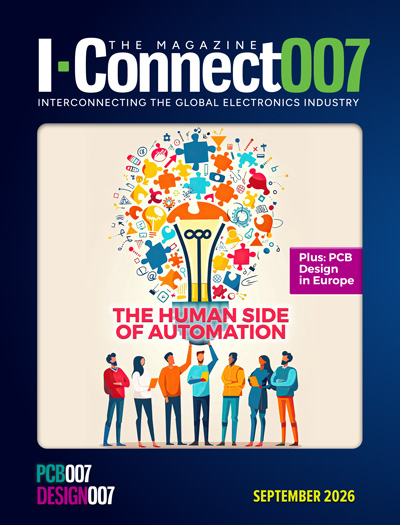
Welcome to the debut issue of I-Connect007 Magazine. This publication brings all of the pieces together from PCB design and fabrication for a closer alignment and a more integrated electronics manufacturing landscape.
Designing Proper Work-Life Balance
In this issue, we hear from designers, marketers, and business owners on how they apply their professional skills to their personal lives to build a healthier work-life balance.
- Articles
- Columns
- Links
- Media kit
||| MENU - I-Connect007 Magazine
How Good Design Enables Sustainable PCBs
August 21, 2025 | Gerry Partida, Summit InterconnectEstimated reading time: 1 minute
Sustainability has become a key focus for PCB companies seeking to reduce waste, conserve energy, and optimize resources. While many discussions on sustainability center around materials or energy-efficient processes, PCB design is an often overlooked factor that lies at the heart of manufacturing.
Good design practices, especially those based on established IPC standards, play a central role in enabling sustainable PCB production. By ensuring designs are manufacturable and reliable, engineers can significantly reduce the environmental impact of their products. Let’s explore how adhering to design rules can directly contribute to sustainability and why poor designs can derail these efforts.
The Hidden Cost of Bad Design
Poorly designed PCBs often result in low manufacturing yields, leading to higher scrap rates. For every lot that fails, manufacturers must remake boards, consuming additional materials, energy, and manpower. This cycle not only increases production costs but also amplifies the environmental footprint of each PCB produced.
For example, a design with inadequate annular rings or insufficient conductor or plane clearances may cause defects such as open circuits or shorts. Badly conceived or overly complex HDI stackups can lead to registration issues, delamination, and other non-compliances. These issues often require rework or remakes, both resource-intensive processes. The wasted copper, laminate, chemicals, and labor could have been avoided with a well-structured, IPC-compliant design.
Identifying Design Issues: Tools and Missed Opportunities
The industry has developed advanced tools to identify design issues early in the process, offering the potential to correct problems before manufacturing begins. PCB design tools like Siemens NPI (New Product Introduction) and fabrication tools like Genesis InSight or Integr8tor allow engineers to perform detailed design rule checks (DRCs) and manufacturability analyses. These tools highlight potential risks in the design, such as misaligned drill files, inadequate copper-to-edge clearances, and poorly optimized stackups.
To continue reading this article, which originally appeared in the August 2025 edition of Design007 Magazine, click here.
Testimonial
"In a year when every marketing dollar mattered, I chose to keep I-Connect007 in our 2025 plan. Their commitment to high-quality, insightful content aligns with Koh Young’s values and helps readers navigate a changing industry. "
Brent Fischthal - Koh YoungSuggested Items
Imec Launches University Consortium Around Next Generation of Chips
03/13/2026 | ImecImec, a world-leading research and innovation hub in advanced semiconductor technologies, has launched a first of its kind consortium with 26 European university groups that will jointly work on the technology roadmap beyond CMOS scaling (CMOS 2.0).
India Advances Toward 85,000 Semiconductor Engineers Under C2S
03/12/2026 | PIB DelhiGovernment of India’s initiative for prioritizing talent development through Training, Up-skilling and Workforce Development Programs under Chips to Startups (C2S) initiative of India Semiconductor Mission (ISM), Union Minister for Railways, Information & Broadcasting, and Electronics & IT, Ashwini Vaishnaw, stated that India has made significant progress in last 04 years itself for its 10-year target of training 85,000 engineers in semiconductor design.
Automating the Repeatable Parts of Hardware Design
03/12/2026 | Kyle Dumont, AllSpice.ioDespite working on some of the most sophisticated technology in the world, many hardware engineers still rely on spreadsheets, tribal knowledge, and sometimes, quite literally, pen, paper, and a highlighter. Delivering new hardware products on schedule often comes down to finding a needle in a haystack disguised as a 900-page specification or datasheet. AllSpice.io set out to automate the repeatable parts of hardware design: the well-defined, rules-based tasks that make sure nothing gets missed and everything lines up.
Introducing Octopart Discover: From Part Search to Solutions Discovery
03/11/2026 | AltiumOctopart, an Altium company, introduced Octopart Discover, the next evolution of Octopart that brings design intent and persistent system context into solutions discovery — moving engineers beyond part search to discovering and evaluating system-fit solutions. Octopart Discover will be showcased at Booth 3A-415 during embedded world.
Zuken Releases Harness Builder for E3.series 2026 for Wire Harness Manufacturing
03/11/2026 | ZukenZuken USA announced the release of Harness Builder 2026, the latest version of its wire harness manufacturing software.