













 Flex Connections: Material Selection in Nickel vs. Copper Tabs
 Flex Connections: Four Lessons in Engineering Judgment for PCB Designers
 Flexible Thinking: ‘Let There Be Light’–Emitting Diodes!






I read an interesting article this week about a breakthrough on building microprocessors to run on microwaves rather than traditional digital circuitry. It cites an academic study that begins, “The development of high-bandwidth applications, including multi-gigabit communication and radar imaging, demands faster processing. However, in the microwave regime, where frequencies exceed clock rates, sampling and computation become challenging. Here we report an integrated microwave neural network for broadband computation and communication.”
The technology could enable a 4–10x increase in compute power over traditional CPUs for processing data streams. Also interesting is that this architecture requires approximately the same amount of electricity as a mobile phone (less than 0.2 watts), whereas most CPUs require around 65 watts. Imagine these promising implications: AI server-level compute power with the power consumption of a cell phone. Given that AI data centers using conventional digital compute architectures are on track to rank as the third-largest “country” for power consumption by 2030, this sort of development could be a resource-usage game changer in the future.
In the present, however, these are my must-reads you should know for the week. The U.S. PCB market is projected to grow by 50% over the next seven years, while the interposer market is expected to triple the size of the PCB market during the same timeframe. Flex and LG are partnering on some new data center thermal management technology, Lockheed Martin released Star.OS to integrate multiple AIs, and Design007 Magazine has released its November issue, this time focusing on power and ground planes.
U.S. PCB Market Projected to Grow to $34.2 Billion by 2033
Published November 11
“Growing demand for electronics, the expansion of the automotive and aerospace industries, improvements in flexible and high-density PCB technology, the growing use of wearable and Internet of Things devices, and investments in 5G, artificial intelligence, and renewable energy technologies are the main factors propelling the U.S. PCB market.” While this is certainly encouraging news for the U.S. market, it’s worthwhile to note that most of this growth is projected to come from consumer and business electronics.
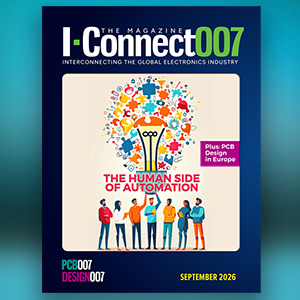
November 2025 Design007 Magazine: Proper Plane Design
Published November 10
The November issue of Design007 Magazine focuses on planes—power and ground planes, to be exact. This issue is packed with wisdom and background on proper design for power and ground planes. Even if you think you know all there is to know about this topic, there is undoubtedly something new to learn. Follow the link to read it now.
Interposer and Fan-Out WLP Market Anticipated to Hit $101.6 Billion by 2032
Published November 7, 2025
As this report suggests, interposer sector growth globally is on a tear. In 2025, the global market weighed in at $24.4 billion (roughly the same as the PCB market cited above), and is on track to exceed $100 billion by 2032. That’s a 4X growth, making it very clear that advanced packaging technologies are on the road to mainstream adoption.
Flex, LG Partner to Develop Advanced Thermal Management Solutions for Gigawatt Data Centers
Published November 7
To help improve heat management inside the data center, Flex is bringing its liquid cooling tech and power products, while LG supplies high-performance air and liquid cooling modules. The idea is that data centers will have a wider range of options for customizing their cooling systems. It remains to be seen whether this collaboration will bring new connectors to the printed circuit board.
Lockheed Martin Revolutionizes AI Integration with STAR.OS™
Published November 8
Lockheed Martin claims this release “enables different AI systems to work together smoothly and effectively.” They claim that a long-standing challenge in the field of AI—a common framework that makes it easier to combine different AI systems and services—is addressed by STAR.OS. Since this is Lockheed Martin, it’s fair to assume this is primarily a Milaero application. But this sort of overarching application was inevitable.


