












 Fresh PCB Concepts: Don't Let Over-specification Come Back to Haunt You
 Elementary, Mr. Watson: A Nightmare on PCB Street
 Connect the Dots: Getting the PCB Quote Right





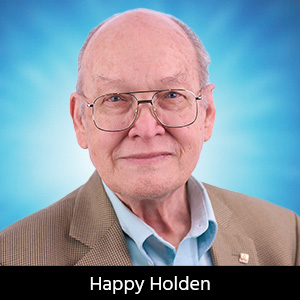
Known as the godfather of PCB process technology, Happy’s Tech Talk columnist Happy Holden has spent over 50 years advancing electronics manufacturing. In this profile, Happy shares stories from HP, Foxconn, and beyond—highlighting a career defined by curiosity, mentorship, and a relentless passion for learning that continues to shape our industry.
Marcy LaRont: Happy, you’ve contributed to the industry’s knowledge base for nearly your entire career. Young engineers seek you out for your columns and books. Where were you born and raised? What’s a favorite childhood memory?
Happy Holden: I was born in Whitewater, Wisconsin. My father was in college on the GI Bill at the time. My cousin had been born in the same bed in the Birthing Center just seven days earlier. I grew up on a farm in Wisconsin, then in Columbia City, Indiana, Toulon, Illinois, and several places in southern California, before my family settled in Corvallis, Oregon.
In 1956, my family went by train to visit my grandmother in San Diego, California, taking the southern route on the El Capitan to see her and the northern route home on the California Zephyr. We went to the new Disneyland and Hollywood. That train trip is one of my favorite childhood memories—so much so that when my young family was living in Taiwan in 1985, we took the boys on a true transcontinental train trip from Perth to Sydney, Australia, getting off the train at Kalgoorlie and Adelaide.
Where did you attend college, and what did you study?
I attended Oregon State University in Corvallis and studied dual degrees in chemical and electrical engineering. I was attending a small mountain high school in Oregon with only 92 students across all four grades, and had taken all the science and math courses it had to offer, so the high school let me attend OSU half-time while I was a senior. From 1962 to 1965, I worked summers for the botany and plant pathology farm services. From 1965 to 1970, I participated in a work-study program in geophysics field research and oceanography. While at OSU, I also served as an engineering tech in the experimental psychology department and for the army reserves.
To continue reading this interview, which originally appeared in the November 2025 edition of PCB007 Magazine, click here.


