







 The Marketing Minute: When Everyone Is a Thought Leader, No One Is
 The Chemical Connection: More Solutions to Common PCB Etching Questions
 It’s Only Common Sense: How to Demonstrate Grace Under Pressure During Tough Times





The I-Connect007 Industry Resource Center brings together expert white papers that help engineers and manufacturers navigate today’s design and manufacturing challenges across the PCB lifecycle.
NCAB Group contributes a valuable collection of white papers focused on practical PCB design and manufacturability. Drawing on their experience with a global network of production partners, NCAB helps engineers align design intent with fabrication realities: reducing risk while improving consistency and long-term reliability.
In “Semi-Flex Design Guidelines,” the team addresses applications that require limited bending without the added cost and complexity of fully flexible circuits. The paper explains how designers can select thin rigid FR-4 materials to enable controlled bending during installation, while emphasizing that semi-flex designs are best suited for static or limited-bend applications. Key considerations include minimum bend radius, copper distribution in bend areas, layer symmetry, and the use of flexible solder mask or coverlay to reduce mechanical stress.
NCAB extends its design-for-manufacturing approach in “Ultra HDI Design Guidelines,” which tackles the challenges of shrinking geometries and increasingly dense interconnect structures. The paper outlines practical design rules for microvias, pad sizes, dielectric thicknesses, and stackups that support both manufacturability and electrical performance as designs move beyond traditional HDI limits.
In “Stackups and Impedance Design Guidelines,” the focus is on the structural foundations that support signal integrity. This paper explains how symmetrical stackups, controlled dielectric spacing, and consistent copper weights help designers meet impedance targets while minimizing warpage in high-speed and high-frequency applications.
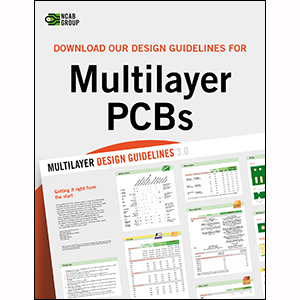
In “Multilayer Design Guidelines,” the authors address copper balance, via strategies, and drilling tolerances. These fundamentals help designers achieve stable manufacturing outcomes as board complexity and layer counts continue to increase.
Together, NCAB Group’s white papers reflect a design-for-manufacturing mindset. By translating fabrication constraints into actionable design guidance, the authors help engineers improve reliability, reduce rework, and achieve more predictable results.
Visit the I-Connect007 Industry Resource Center to explore these resources—and many more—designed to strengthen your PCB design strategy.