













-
- News
- Books
Featured Books
- I-Connect007 Magazine
Latest Issues
Current Issue
Beyond the Rulebook
What happens when the rule book is no longer useful, or worse, was never written in the first place? In today’s fast-moving electronics landscape, we’re increasingly asked to design and build what has no precedent, no proven path, and no tidy checklist to follow. This is where “Design for Invention” begins.
March Madness
From the growing role of AI in design tools to the challenge of managing cumulative tolerances, these articles in this issue examine the technical details, design choices, and manufacturing considerations that determine whether a board works as intended.
Looking Forward to APEX EXPO 2026
I-Connect007 Magazine previews APEX EXPO 2026, covering everything from the show floor to the technical conference. For PCB designers, we move past the dreaded auto-router and spotlight AI design tools that actually matter.
- Articles
- Columns
- Links
- Media kit
||| MENU - I-Connect007 Magazine
Make the Smart Move
April 7, 2026 | Stephen V. Chavez, Siemens EDAEstimated reading time: 1 minute
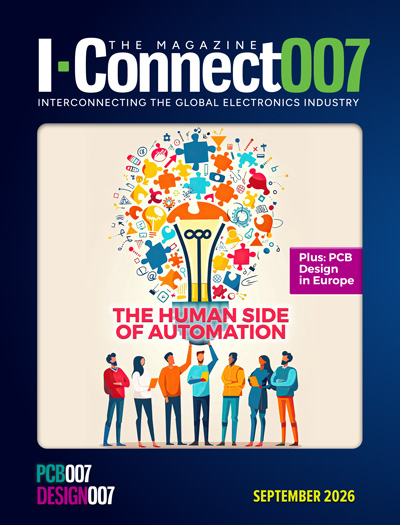
It’s incredibly easy to become fixated on shiny new EDA software, the latest high-speed routing algorithms, or the most advanced fabrication techniques. New tools and technologies are creating sophisticated simulation platforms that automate routing, check design rules, and simulate performance. However, they cannot replicate the nuanced judgment, imaginative solutions to space constraints, or collaborative spirit that define printed circuit engineering excellence. That is your most significant return on investment.
The Human Element: The Unsung Hero of PCB Innovation
Printed circuit engineering translates customer requirements into complex system architectures and electrical schematics that become physical realities by navigating signal integrity challenges, optimizing for manufacturability, and ensuring reliability across diverse environments. It ties directly to the three competing perspectives of the designer’s triangle: solvability, performance, and manufacturing.
Prioritizing the printed circuit engineer can be a game-changer in the following ways:
- Unlocks potential in design and analysis. A highly skilled and well-supported PCB engineer can extract far more value from a standard EDA suite than an under-trained or disengaged engineer can from the most sophisticated one. Training them in advanced layout techniques, signal integrity analysis, power integrity simulation, and DFM principles helps them better understand the underlying physics of high-speed signals, push the boundaries of layer stackups, and even foresee manufacturing challenges the tool's automated features might miss.
- Fosters innovation and adaptability in a rapidly evolving field. Engineers who are familiar with new substrate materials, advanced packaging, and evolving industry standards are far more adaptable. They can quickly grasp new technologies, integrate them into existing design workflows, and even envision entirely new applications, from flexible circuits to embedded components, that the tool's creators might not have imagined.
To continue reading this article, which originally appeared in the March 2026 edition of I-Connect007 Magazine, click here.
Testimonial
"Our marketing partnership with I-Connect007 is already delivering. Just a day after our press release went live, we received a direct inquiry about our updated products!"
Rachael Temple - AlltematedSuggested Items
Meet Emerging Engineers: Patrick Owen and Eric Mickenbecker, Summit Interconnect
05/05/2026 | Michelle Te, I-Connect007Patrick Owen and Eric Mickenbecker both work for Summit Interconnect, and are in their second year of the Global Electronics Association’s Emerging Engineer Program with mentor Brian Chislea. They stopped by the I-Connect007 booth at APEX EXPO and shared a bit of their story with me. Patrick has worked at the Hollister, California, plant since 2018, while Eric has been at the Chicago site since 2023. Like many of their peers, they came to the electronics industry from different paths, but are both excited about making an impact.
Nolan’s Notes: Our Spotlight on North America
05/05/2026 | Nolan Johnson -- Column: Nolan's NotesIn this issue of SMT007 Magazine, we wrap up our electronics world tour with a final stop in the United States and Canada, where we look at the challenges, opportunities, and geopolitical dynamics affecting the market today. What makes American electronics unique? Key U.S. administration policy decisions, like tariffs, are significantly affecting electronics manufacturing. Others, such as the current conflict with Iran and the associated closures of the Strait of Hormuz, affect the raw materials that feed our supply chain.
PCBAA, AAM Take on the Fight to Rebuild U.S. Manufacturing in New Documentary
05/05/2026 | Marcy LaRont, I-Connect007Throughout most of the 20th century, manufacturing was central to the American Dream of providing stable jobs and pathways to upward mobility. Today, more than 80% of global electronics manufacturing capacity resides in China and greater Asia, raising serious concerns about supply chain resilience and national security.
Dan’s Biz Bookshelf: ‘The Next RenAIssance: AI and the Expansion of Human Potential’
04/29/2026 | Dan Beaulieu -- Column: Dan's Biz BookshelfZack Kass delivers something truly special in "The Next RenAIssance: AI and the Expansion of Human Potential," a book that doesn’t just explain artificial intelligence—it reframes how we think about our future as individuals, leaders, and innovators. Written in a tone that is both accessible and deeply insightful, Kass manages to turn a complex, often intimidating subject into an energizing call to action. This is not a book about machines replacing humans. It’s a book about humans becoming more of who they’re capable of being.
How Are You Vetting Your Supply Chain?
04/28/2026 | Didrik Bech, CONFIDEEFor many years, supplier management was largely focused on standard commercial priorities: cost, quality, lead time, and delivery performance. If a supplier met specifications, shipped on time, and remained price competitive, the relationship was often considered healthy. However, the world has changed.