














 Elementary, Mr. Watson: Waking Up Europe's PCB Giants
 Connect the Dots: Getting the PCB Quote Right
 Powering the Future: What Engineers Get Wrong About Designing for Reliability





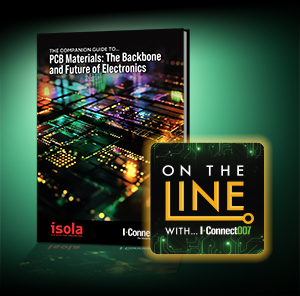
The base material of a printed circuit board is its literal and functional foundation. Isola, founded in 1912 in Düren, Germany, is one of the longest-standing manufacturers of glass-reinforced laminates in the electronics industry. Originally focused on insulation and fiberglass materials, the company played an early role in supplying the foundational substrates that enabled the growth of PCB technology. As electronics advanced, Isola evolved alongside the industry, expanding from basic glass-epoxy laminates into high-performance copper-clad materials and engineered prepregs.
Today, over 100 years after its founding, Isola supports high-speed digital, RF/microwave, automotive, and aerospace applications.
I recently spoke with several Isola subject matter experts as part of I-Connect007’s On the Line with… podcast series. Timely as ever, this podcast hits the mark for an industry grappling with advanced technology mandates that require designers and manufacturers to invent and innovate as they manufacture.
The six-episode series offers a focused look at the evolving role of PCB materials. I highly recommend these short, informative episodes.
Episode 1
In the first episode of On the Line with…PCB Materials: The Backbone and Future of Electronics, Sean Mirshafiei, president of Isola, discusses the critical role that PCB base material has played, and continues to play, in electronics manufacturing. As today’s technology demands drive the development of new material solutions, Sean also explores Isola’s role in the electronics manufacturing ecosystem and the material suites they are bringing to market to address challenges in reliability, signal integrity, and power performance.
Episode 2
It’s no surprise that AI is transforming the rules of electronics, demanding speed, power, and frequency performance beyond what traditional materials offer. In this episode, Isola’s Drew Delaney provides a firsthand look at the materials science enabling hyperscale AI data centers, 5G antennas, and rugged edge devices. From ultra-low-loss laminates to boards designed to withstand extreme environments and long lifecycles, Drew outlines what materials must deliver in a world pushing beyond 400G performance.
Episode 3
As sustainability and circularity take center stage across electronics manufacturing, PCB base materials are becoming a key part of the conversation. In this episode, Isola CTO Kirk Thompson introduces the concept of the “green circuit,” exploring how materials and processes can reduce energy use, minimize waste, and address environmental concerns such as VOC emissions and PFAS. From halogen-free options to smarter design choices, this discussion highlights the growing importance of environmentally responsible materials.
Episode 4
In the fourth episode, I speak with Laura Martin, director of strategic markets at Isola, about reliability in harsh environments across aerospace, automotive, and defense applications. Laura explains that reliability under pressure is not just about temperature limits, but about managing cyclic strain within composite materials. Thermal cycling, Z-axis expansion, moisture under bias, and anisotropic behavior all contribute to long-term fatigue and failure. From plated through-hole cracking to interfacial delamination, this conversation underscores the importance of designing with real-world stress factors in mind to ensure long-term durability and performance.
Episode 5—Dropping tomorrow!
Here, the conversation shifts from materials to the systems that support them. Isola’s Chief Sales Officer Jim Hartzell shares lessons learned from recent global supply chain disruptions, highlighting how long-standing priorities around efficiency left many supply chains vulnerable. As volatility becomes the norm, the discussion explores how companies can build resilience through diversification, scenario planning, strategic inventory, and stronger partnerships.
Episode 6—Coming April 30
In the series wrap-up, CTO Kirk Thompson discusses the turning point facing the PCB industry as innovation speeds up. With increasing data rates, power density, AI infrastructure, flexible electronics, photonics, and chiplet integration, traditional material assumptions are no longer enough. Kirk explains how advanced materials now enable higher speeds, better thermal management, and more precise dimensional control, while balancing manufacturability. The merging of PCBs and advanced packaging is both exciting and challenging, requiring substrate-like precision at scale. In the end, early collaboration across the ecosystem and smarter, more integrated materials will shape the next generation of cutting-edge PCBs.
Finally, please download and enjoy the free companion guide to this podcast, available here, where you’ll also find this podcast series.


