












Introducing FKN Systek Depanelizer with Linear Guide Table for Small PCBs
April 20, 2026 | FKN SystekEstimated reading time: 1 minute
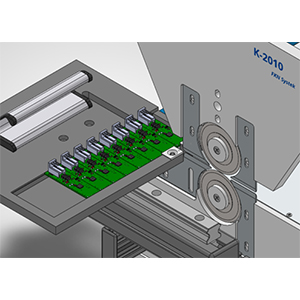
Singulating small PCBs with circular blade depanelizers can be a tedious repetitive process which can easily result in board damage due to operator fatigue. Increase process quality and safety by using the FKN Systek K2010 motorized circular blade depanelizer with a support table to separate the V-Scored boards.
The operator places the panel onto the front and back guide rails and brings it forward through the front blade guards to be singulated by two 2.5 “ dia. Circular blades. The front blade guards are adjustable so that panel can only be moved forward if the score-line is nested on the lower guide. Two blade guards at the output side of the cutting area prevent operator access to the sharp blades.
The PCB support rail on the left input side of the guide table have an adjustable board stop which can be set to quickly position each panel precisely to enter the cutting plane at the V-Score. Standard support tables have a front and back guide rail which can be universally adjusted to fit a variety of smaller V-Scored PCBs. Customized nesting plates can be designed to your specs for secure board handling during the depaneling process.
Proudly made in the USA, FKN Systek offers customizable tooling and in-line systems. Our durable HSS blades are designed for long life and can be resharpened.
For more information look up our web site at fknsystek.com or email us at FKN@FKNSYSTEK.com.
Testimonial
"Your magazines are a great platform for people to exchange knowledge. Thank you for the work that you do."
Simon Khesin - Schmoll MaschinenSuggested Items
A Necessary Shift From Gerber to IPC-2581
05/07/2026 | Tracy Riggan, Global Electronics AssociationIPC-2581 is an open, vendor-neutral data exchange standard developed by the Global Electronics Association to streamline the exchange of PCB design information across fabrication, assembly, and test. It replaces multiple legacy formats—including industry standards, Gerber, and ODB++—with a single, comprehensive, XML-based dataset that captures all manufacturing details.
NVIDIA, Corning Partner to Boost U.S. AI Manufacturing
05/06/2026 | BUSINESS WIRENVIDIA and Corning Incorporated announced a multiyear commercial and technology partnership to dramatically expand U.S.-based manufacturing of the advanced optical connectivity solutions needed to power next-generation AI infrastructure.
When Quality Is Personal: The Human Stakes Behind Electronics Reliability
05/06/2026 | Kelly DackIn electronics manufacturing, quality is often discussed in terms of specifications, standards, and process controls, but as industry veteran Doug Pauls reminds us, the stakes are far more human. In this conversation, Doug, a recipient of the Global Electronics Association’s Hall of Fame Award, draws on more than four decades of experience to illuminate the real-world consequences of reliability, where even a single defect can carry profound implications. He brings into sharp focus why quality isn’t just a metric, but a responsibility shared by everyone on the manufacturing floor.
Connect the Dots: Designing for the Future of Manufacturing Reality—Surface Finish
05/07/2026 | Matt Stevenson -- Column: Connect the DotsWhen designing the complex boards that many electronic devices require to operate, designers should consider manufacturability at every step. This is my last article focused on designing for the always-evolving manufacturing reality. Choosing the right surface finish has always been important. If you are creating intricate designs with a wide variety of components, like for an ultra-high density interconnect (UHDI) board, surface finish is a critical last step.
Learning with Leo: Drones—Meeting Demand Without Compromise
05/06/2026 | Leo Lambert -- Column: Learning With LeoWith drones used in a wide range of applications today, particularly in modern military conflicts, domestic manufacturers are feeling pressure to produce at high volume and low cost, particularly within an NDAA supply chain ecosystem with differing needs and expectations. Two issues must be considered. First is the manufacturers’ and customers’ need for quality, reliability, and functionality of the product. Second is the manufacturing volume needed to support demand, whether for military, industrial, or commercial applications. Each segment requires verification that the product meets the customer's requirements.