













-
-
News
News Highlights
- Books
Featured Books
- I-Connect007 Magazine
Latest Issues
Current Issue
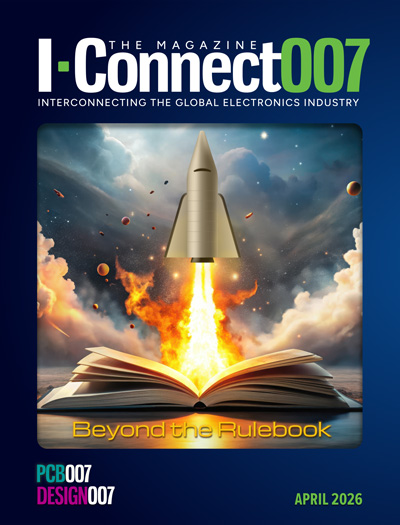
Beyond the Rulebook
What happens when the rule book is no longer useful, or worse, was never written in the first place? In today’s fast-moving electronics landscape, we’re increasingly asked to design and build what has no precedent, no proven path, and no tidy checklist to follow. This is where “Design for Invention” begins.
March Madness
From the growing role of AI in design tools to the challenge of managing cumulative tolerances, these articles in this issue examine the technical details, design choices, and manufacturing considerations that determine whether a board works as intended.
Looking Forward to APEX EXPO 2026
I-Connect007 Magazine previews APEX EXPO 2026, covering everything from the show floor to the technical conference. For PCB designers, we move past the dreaded auto-router and spotlight AI design tools that actually matter.
- Articles
- Columns
- Links
- Media kit
||| MENU - I-Connect007 Magazine
Absolute EMS Expands Support for LEO, MEO, and GEO Satellite Programs
May 13, 2026 | Absolute EMS, Inc.Estimated reading time: 2 minutes
Absolute EMS, Inc., a Silicon Valley–based provider of high-technology electronics manufacturing services, continues to grow its presence in the satellite sector, supporting programs across low Earth orbit (LEO), medium Earth orbit (MEO), and geostationary orbit (GEO) with advanced PCBA manufacturing, test, and sub-assembly capabilities.
As satellite designs evolve, so do the manufacturing demands behind them. LEO systems must withstand frequent thermal cycling and exposure to atomic oxygen, while MEO and GEO platforms are expected to operate for years—often decades—without the possibility of service. Across all orbits, the expectation is the same: consistent quality and long-term reliability under harsh conditions.
Absolute EMS has aligned its processes to meet those expectations. The company has developed an intensified touchless manufacturing approach designed to reduce handling-related variability and maintain tighter process control throughout production. Combined with high quality standards, full traceability, and a workforce certified to IPC J-STD-001 Class 3—including Space Addendum requirements—this approach helps ensure assemblies are built to perform in environments where failure isn’t an option.
Another ongoing challenge in satellite design is weight. Reducing mass directly impacts launch cost and system efficiency, and it requires precision at the component level. Absolute EMS supports this need with experience in assembling ultra-miniature components, including 008004 imperial package sizes, enabling customers to push designs further without compromising build quality.
With a background supporting high-reliability industries such as medical, military, and industrial electronics, Absolute EMS brings a practical understanding of controlled manufacturing environments and strict documentation requirements. That experience continues to translate naturally into the satellite sector, where traceability, repeatability, and process discipline are critical.
“Our customers are building systems that need to perform in very different environments depending on orbit, but the expectations around quality and reliability don’t change,” said Doug Dow, COO at Absolute EMS. “Our focus is on building processes that support that consistency, regardless of the application.”
As demand for satellite technology continues to grow, Absolute EMS is positioned to support a range of programs from emerging LEO constellations to long-life GEO platforms while maintaining a steady focus on quality, precision, and manufacturability.
Testimonial
"We’re proud to call I-Connect007 a trusted partner. Their innovative approach and industry insight made our podcast collaboration a success by connecting us with the right audience and delivering real results."
Julia McCaffrey - NCAB GroupSuggested Items
Rethinking Reinforcement Materials for Advanced Packaging
05/14/2026 | Ivana Ivanovic-Hesselink, Flexiramics B.V.Materials that once quietly supported the industry are now becoming limiting factors. The electronics industry is experiencing unprecedented pressure as RF systems push into mmWave frequencies, high-speed digital architectures advance into their next performance generation, and power densities climb across automotive, telecom, aerospace, and computing. Reinforcement materials, long treated as a background detail in laminate design, are suddenly at the centre of performance, reliability, and supply‑chain discussions.
LITEON Technology Reports Consolidated April Sales of NT$16.7 Billion, Up 25% YoY and 1% MoM
05/14/2026 | LITEON TechnologyLITEON Technology reported its April consolidated revenue of NT$16.7 billion, up 1% M-o-M and 25% Y-o-Y. Revenue growth was mainly driven by high-end server power systems for cloud and AI applications, high‑efficiency backup battery units (BBU), and opto-electronic semiconductors.
Keytronic Posts Results for Q3 of Fiscal Year 2026
05/14/2026 | KeytronicFor the third quarter of fiscal year 2026, Key Tronic reported total revenue of $89.6 million, compared to $112.0 million in the same period of fiscal year 2025.
Road to Reliability: Engineering High Uptime EV Charging Infrastructure
05/13/2026 | Stanton Rak, SF Rak CompanyThe transition to EVs is no longer constrained solely by vehicle capability. Instead, it is increasingly defined by a simpler, but more unforgiving question: Will the charger work when I arrive? This high uptime does not happen by accident. As EV technology has matured, limitations in battery range, power electronics, and thermal management are no longer the primary barriers to adoption.
Protecting Advanced Trucking Electronics in Harsh Environments
05/13/2026 | Beth Massey, MacDermid Alpha Electronics SolutionsFor decades, trucking was defined by horsepower, payload, and driver endurance. Today, the competitive edge lies in electronics, as advanced sensing, communications, and data processing systems reshape how commercial vehicles operate. The industry is rapidly digitizing, with electronic systems now critical to safety, uptime, and fleet efficiency. Technologies like ADAS, radar, lidar, and telematics enable real-time decision-making, while distributed sensors monitor key vehicle functions. Because these systems operate in harsh conditions, environmental protection using potting, coatings, and encapsulation is now a core design priority.