
















 Elementary, Mr. Watson: Waking Up Europe's PCB Giants
 Connect the Dots: Getting the PCB Quote Right
 Powering the Future: What Engineers Get Wrong About Designing for Reliability





For many PCB fabricators, solder mask imaging can become one of the biggest constraints on production. Traditional exposure methods often involve lengthy setup times, multiple process steps, and opportunities for registration errors, leading to costly rework.
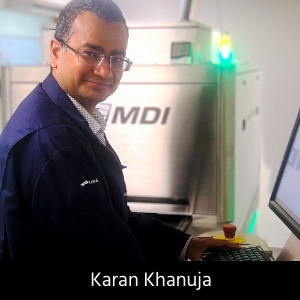
ZOT Engineering Ltd., a UK-based contract electronics manufacturer specializing in PCB fabrication and assembly, recently modernized this part of its process by partnering with Schmoll Maschinen to deploy a maskless direct imaging (MDI) system. We spoke with Karan Khanuja, a senior process engineer at ZOT, about the challenges they faced, how they evaluated the technology, and what changed after implementation.
Marcy LaRont: What prompted you to look at direct imaging for solder mask?
Karan Khanuja: Our previous process relied on conventional camera-based exposure systems. They worked, but they required a significant amount of setup. Aligning the camera to each panel could take up to 30 minutes, and if registration wasn't perfect, we'd end up reprocessing the board. Over time, that became a real production bottleneck.
We were also looking to add redundancy to our imaging capability so production wouldn't stop during maintenance or unexpected downtime.
LaRont: How did you approach evaluating new equipment?
Khanuja: We visited three different European manufacturers and benchmarked each system using our own production requirements. Seeing the equipment in operation was important because we wanted to compare not only image quality and capability but also ease of implementation and the level of technical support available.
Ultimately, we selected the system that best fit our manufacturing environment and offered the flexibility we were looking for.
LaRont: How difficult was the installation process?
Khanuja: It was fairly straightforward, and installation took about a week. The first few days focused on getting the machine connected to our utilities, network, and supporting infrastructure. The remainder of the week was dedicated to operator training and process validation.
Before releasing the machine into production, we repeated the same benchmark panels we had qualified during our evaluation, which gave us confidence that the results would be consistent.
LaRont: Was operator training a challenge?
Khanuja: Not really. The user interface was familiar because we already had experience with similar equipment. That shortened the learning curve considerably. Even for operators who were new to the machine, the software was intuitive enough that they became comfortable fairly quickly.
LaRont: What operational improvements have you seen since making the transition?
Khanuja: Probably the biggest improvement has been registration accuracy. We no longer experience the solder mask alignment issues that previously required rework. Eliminating that has reduced scrap, saved labor, and made scheduling much more predictable.
The process itself is also faster. Because we no longer create films for each job, we've removed several manual steps from production.
LaRont: Have you seen measurable cost savings?
Khanuja: Yes. The most obvious savings come from eliminating film production. Every job previously required film, along with the labor needed to produce it. We've also eliminated the maintenance costs associated with the film plotting equipment.
Those savings add up over time, but just as importantly, we've simplified the overall workflow.
LaRont: How has the technology expanded the types of work you can accept?
Khanuja: Improved registration accuracy has enabled us to manufacture boards with tighter tolerances and finer features than we could previously produce comfortably. That has opened opportunities with customers whose requirements previously would have been difficult for us to meet.
LaRont: How has this affected overall production flow?
Khanuja: Solder mask imaging is no longer the bottleneck it once was. The process is more predictable, throughput has improved, and downstream operations aren't waiting for imaging to catch up. That benefits both our production team and our customers.
LaRont: Have you seen benefits beyond solder mask imaging?
Khanuja: Absolutely. One advantage of the system is its flexibility. While it's primarily used for solder mask production, it can also serve as a backup for other imaging processes if necessary. Having that redundancy provides additional peace of mind.
LaRont: How important has it been to have supplier support?
Khanuja: Very important. Any manufacturing operation depends on equipment uptime, so responsive technical support matters. Remote diagnostics have allowed issues to be resolved quickly, minimizing disruption to production.
LaRont: Making a big capital investment in a new machine or process is a process. Looking back, is there something that stands out most about the project now that you are in full operations mode?
Khanuja: The biggest takeaway is that improving one process step can have a significant impact across the entire factory. By eliminating a bottleneck, reducing rework, and simplifying the workflow, we've improved efficiency well beyond the imaging department itself.


