














 The Right Approach: Old Philosophies, New Tools
 Trouble in Your Tank: HDI and UHDI—Building the Foundation of Advanced Packaging
 It’s Only Common Sense: Look Beyond the Tariffs





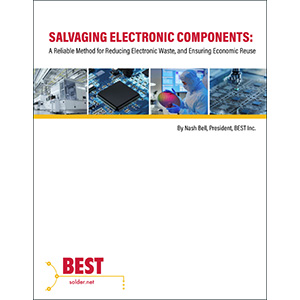
Electronic waste is typically discussed in terms of recycling, but recycling is only one way to recover value from discarded electronics. In the white paper “Salvaging Electronic Components: A Reliable Method for Reducing Electronic Waste, and Ensuring Economic Reuse,” Nash Bell, president of BEST Inc., examines a different approach: harvesting high-value components from obsolete or superseded PCBs, reconditioning them, and putting them back into service.
The approach has the potential to reduce electronic waste, conserve manufacturing resources, and provide an additional source of valuable or hard-to-find components. But successful reuse depends on careful removal, reconditioning, inspection, and testing.
Here are three key takeaways from the white paper.
1. Recycling Shouldn’t Always Be the First Stop
Recycling helps recover valuable metals and rare earth elements from electronic waste, but Bell makes an important distinction between recycling and circularity. Recycling is ultimately a process of breaking down discarded electronics to recover their constituent materials. Circularity seeks to keep products and components useful for as long as possible before that step becomes necessary.
That distinction matters for high-value electronic components. Instead of immediately reducing a functioning semiconductor device to raw materials, component salvage can preserve the value already invested in manufacturing it. This is particularly useful with legacy components, where a single obsolete or difficult-to-source chip may be all that is needed to keep an older piece of industrial equipment operating.
There is also a resource argument. Semiconductor fabrication requires significant amounts of energy and ultra-purified water. The paper cites an estimated 1,500–2,500 kWh to manufacture a single 300 mm semiconductor wafer, before accounting for raw-material extraction, transportation, distribution, or device packaging. Extending the useful life of existing components can therefore conserve resources beyond simply keeping material out of a landfill.
2. Salvage Is a Controlled Manufacturing Process
Recovering a component is not simply a matter of heating the solder and pulling the device from the board. The condition and history of the component, its moisture sensitivity, exposure to electrostatic discharge, electrical overstress, and previous environmental conditions must all be considered.
Bell emphasizes pre-baking as one important safeguard. Moisture trapped in sensitive devices can vaporize during desoldering or reflow, potentially causing cracking, delamination, or “popcorning.” Proper pre-baking helps remove that moisture before the component is exposed to elevated temperatures.
Removal itself also requires process control. Hot-air systems provide uniform heating but require careful management of airflow, temperature, and dwell time. Infrared systems can localize heat and reduce thermal exposure to surrounding components, but their effectiveness depends on factors such as component color, reflectivity, and board material. In either case, thermal profiling and proper MSD handling are essential.
Once removed, components may require reconditioning, including deballing and reballing for BGA devices. Inspection then verifies factors such as coplanarity, solder-ball height and volume, missing balls, shorts, and foreign debris. X-ray or endoscopic inspection can provide additional assurance of the integrity of the interconnection.
3. Reuse Only Works When Reliability Comes With It
The environmental and economic benefits of component reuse do not eliminate its risks. Salvaged components have a history, and some of that history may be unknown.
A device may have experienced electrical overstress, thermal cycling, contamination, moisture exposure, or mechanical damage during its previous service life or removal. Even a component that appears intact can contain hidden degradation that could contribute to premature failure after installation in another assembly.
For that reason, Bell presents testing as an integral part of responsible component reclamation. Depending on the risk, the paper identifies options ranging from microscopy, X-ray inspection, solderability testing, and XRF to electrical testing, burn-in, temperature cycling, scanning acoustic microscopy, and other reliability tests. High-reliability applications understandably demand the greatest scrutiny.
That focus on workmanship and reliability is also where the larger industry conversation is headed. BEST is participating in the development of the IPC-7712 Component Reclaim Standard, an effort intended to advance circularity and expand opportunities for component reuse rather than disposal or material recycling.
Conclusion
Component salvage reframes electronic waste as more than a source of recyclable material. In the right circumstances, discarded assemblies can also be a source of usable electronic components whose manufacturing costs have already been covered by energy, materials, and resources.
The opportunity, however, depends on proper reclamation. Controlled removal, proper reconditioning, thorough inspection, and risk-appropriate testing are what turn component salvage from a waste-reduction idea into a practical circular manufacturing strategy.
Download the paper from the Industry Resource Center located here.


