
















 Fresh PCB Concepts: Don't Let Over-specification Come Back to Haunt You
 Elementary, Mr. Watson: A Nightmare on PCB Street
 Connect the Dots: Getting the PCB Quote Right





Gold prices have risen dramatically over the past decade, putting additional pressure on PCB fabricators to control costs without compromising the finishes their customers require. For ENIG and ENEPIG processes, however, the opportunity to reduce costs may also present an opportunity to improve sustainability.
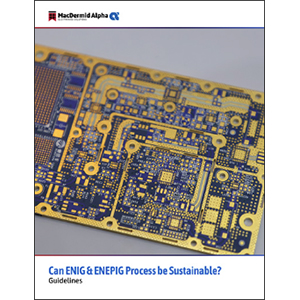
In its white paper, “Can ENIG & ENEPIG Process be Sustainable?” MacDermid Alpha Electronics Solutions provides guidelines for where the greatest opportunities exist to reduce gold consumption, chemistry use, energy demand, and waste while continuing to meet established performance requirements.
Here are three key takeaways from the paper.
- Start with gold
When looking for ways to make ENIG and ENEPIG more economical, chemistry might seem like an obvious place to start. But, at current market prices, more than 90% of the ENIG cost comes from gold, compared with just 3.9% from process chemistry. MacDermid Alpha also reports that 87.4% of the gold used in the process is deposited directly on the board, making deposited gold one of the largest variables fabricators can directly control.
The takeaway is not simply to plate less gold, however. It is to understand how much gold is actually necessary to reliably meet the required specification, and where excess material may be entering the process.
- Better measurement creates room to optimize
Reducing gold thickness requires confidence in the measurement system behind it. If XRF measurements are inconsistent, fabricators may compensate by targeting a higher average thickness to ensure every board remains safely above the required minimum.
The paper emphasizes qualifying the measurement system before attempting to optimize the process. Longer XRF count times, appropriate calibration standards, and gage studies can help expose actual process variation rather than measurement variation.
That tighter control can translate into significant savings. In the production example presented in the paper, two ENIG processes were run to the same IPC-4552B minimum thickness. The process with the tighter distribution achieved a 14.47% lower average gold thickness. The production volume modeled in the paper represented more than 6,253 grams of gold and approximately $668,000 in projected annual savings.
It was the specification that changed, but the amount of excess gold required to reliably meet it.
- Look beyond gold for additional sustainability gains
Gold represents the largest financial opportunity, but it is not the only place where ENIG and ENEPIG processes can become more efficient.
The paper points to several additional improvements, including extending electroless nickel bath life from three to six MTO, eliminating dummy plating with newer electroless nickel processes, and reducing immersion gold operating temperatures from 82°C to 40°C.
These changes address different parts of the sustainability equation: less spent chemistry, less waste, and lower energy consumption. In the model presented, operating at the lower temperature reduced annual energy consumption from 132,000 kWh to 32,000 kWh, with corresponding modeled CO2 emissions dropping from 125,889 pounds to 30,519 pounds.
Ultimately, the paper makes the case that improving the sustainability of ENIG and ENEPIG does not necessarily require choosing between environmental goals, cost, and performance. It can begin with understanding the existing process more precisely and identifying where tighter control can eliminate material, energy, and chemistry that were never needed in the first place.
The white paper is included in the I-Connect007 Industry Resource Center for technical content. Click here to gain access to the paper.


