















 Dan’s Biz Bookshelf: ‘Building a Story Brand 2.0’
 It’s Only Common Sense: Why Should They Take Your Call?





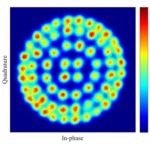
A group including University of Tokyo researchers used 64 APSK, a highly efficient signal modulation technology, to successfully demonstrate 505 megabits per second (Mbps) communications with the Hodoyoshi-4 nanosatellite, the highest communication speed yet achieved with an earth-observation micro satellite. This high-speed communications technology will be of great value to future generations of earth observation micro satellites of under 100 kg.
Amplitude and phase constellation of the 64 APSK signal from the Hodoyoshi #4 micro satellite. Image of data transmitted from the Hodoyoshi #4 satellite orbiting some 600 km above the Earth to the earth station at ISAS Sagamihara. Amplitude (radius) and phase (azimuthal angle) are plotted in this color-coded map. Color codes show the frequency of occurrence of events, with red indicating more frequent occurrence. The transmitted data can be decoded from this view without error. Image credit: Hirobumi Saito.
In recent years Earth observation satellites are increasingly being equipped with high resolution cameras and radar able to discern objects of a few tens of centimeters in size. High-speed transmission systems are required to transmit the observational data obtained from such sensors to the surface of the Earth. However, the frequency bandwidth available for such use is limited, so in order to speed up transmission speeds, research has focused on development of technologies that make efficient use of the available frequency bandwidth.
When using electromagnetic waves to transmit digital data, information can be assigned to each combination of phase (frequency) and amplitude so that when the wave is received, the original information can be decoded by estimating the phase and amplitude that was transmitted. One promising technology that makes efficient use of frequency bandwidth and that is being pursued is 64 APSK modulation, or 64 amplitude phase modulation. In 64 APSK modulation, the 64 possible combinations of amplitude and phase allow the transmission of 6 bits of information, making it 1.5 to 2 times more efficient than conventional technologies. However, it is highly susceptible to noise and had yet to be demonstrated in Earth observation satellite.
Page 1 of 2


