














 The Marketing Minute: When Everyone Is a Thought Leader, No One Is
 The Chemical Connection: More Solutions to Common PCB Etching Questions
 It’s Only Common Sense: How to Demonstrate Grace Under Pressure During Tough Times





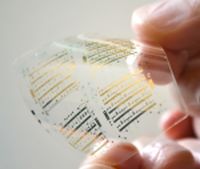
Stuart Higgins (Cavendish Laboratory) discusses the technology being developed to create flexible displays.
It’s common to first see exciting new technologies in science fiction, but less so in stories about wizards and dragons. Yet one of the most interesting bits of kit on display at this year’s Consumer Electronics Show (CES) in Las Vegas was reminiscent of the magical Daily Prophet newspaper in the Harry Potter series.
Thin, flexible screens such as the one showcased by LG could allow the creation of newspapers that change daily, display video like a tablet computer, but that can still be rolled up and put in your pocket. These plastic electronic displays could also provide smartphones with shatterproof displays (good news for anyone who’s inadvertently tried drop-testing their phone onto the pavement) and lead to the next generation of flexible wearable technology.
But LG’s announcement is not the first time that flexible displays has been demonstrated at CES. We’ve seen similar technologies every year for some time now, and LG itself unveiled another prototype in a press release 18 months ago. Yet only a handful of products have come to market that feature flexible displays, and those have the displays mounted in a rigid holder, rather than free for the user to bend. So why is this technology taking so long to reach our homes?
How displays work
Take a look at your computer screen through a magnifying glass and you’ll see the individual pixels, each made up of three subpixels – red, green, and blue light sources. Each of these subpixels is connected via a grid of wires that criss-cross the back of the display to another circuit called a display driver. This translates incoming video data into signals that turn each subpixel on and off.
How each pixel generates light varies depending on the technology used. Two of the most common seen today are liquid crystal displays (LCDs) and organic light emitting diodes (OLEDs). LCDs use a white light at the back of the display that passes through red, green and blue colour filters. Each subpixel uses a combination of liquid crystals and polarising filters that act like tiny shutters, either letting light through or blocking it.
OLEDs, on the other hand, are mini light sources that directly generate light when turned on. This removes the need for the white light behind the display, reducing its overall thickness, and is one of the driving factors behind the growing uptake of OLED technology.
Page 1 of 2


