







 The Marketing Minute: Marketing Is a Team Sport
 The Right Approach: Old Philosophies, New Tools
 Trouble in Your Tank: HDI and UHDI—Building the Foundation of Advanced Packaging





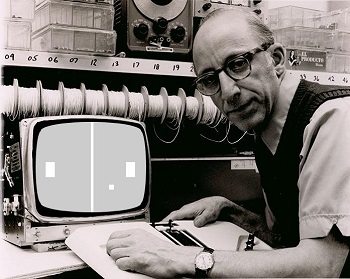
Anyone familiar with popular culture will tell you: Video games are a favorite pastime for people of all ages the world over. In fact, in 2018, the video game industry grew into a $135 billion market. Years of innovation by a team of BAE Systems engineers, led by inventor Ralph Baer, contributed to this industry.
By 1966, increasing numbers of Americans were introducing television sets into their homes. BAE Systems Director of Engineering, Ralph H. Baer was keenly aware of this growing trend and one day, while sitting at a bus stop, he brainstormed ways to make television sets even more entertaining. He jotted down all the different types of games he imagined could be played on a television, including table tennis, auto racing and chess. Baer’s son Mark says – like most engineers – his father had an almost childlike fascination with trying to create new things. “Ralph thought about using the television as more than just a box to stare at,” he said.
BAE Systems gave Baer the green light to assemble a team of engineers to bring his vision for the television into focus. For three years, Baer and his team - working out of their lab on Canal Street in Nashua, N.H. - developed technology that would revolutionize the way so many of us now spend our time.
In fact, 2019 marks a milestone.
Fifty years ago - in 1969 - Baer’s team officially unveiled the very first multiplayer television video game system which they nicknamed “The Brown Box.” The Brown Box – which referred to the wood-grain, self-adhesive vinyl that covered the console – introduced and featured a pair of controls and a multigame program system, the basic features most home video game units still have today. On that first system, one could play table tennis, checkers, four different sports games, target shooting with a light gun, and a golf putting game.
In 1971, Baer and BAE Systems – then known as Sanders Associates – filed for the first video game patent. The Brown Box was licensed to Magnavox and sold as the “Odyssey” in 1972 – the world’s first home video game system. Then in 1973, BAE Systems was assigned the patent for the “Television Gaming and Training Apparatus”.
No one could have fully anticipated it then, but Odyssey laid the groundwork for today’s multi-billion dollar gaming industry. As a result, Ralph Baer has been called “the father of the video game.” Baer is also recognized as “an icon of American Innovation” and was inducted into the National Inventor’s Hall of Fame and received the National Medal of Technology. His artifacts, papers and even his workshop are on display at the Smithsonian National Museum of American History in Washington, D.C.
“He got the support from Sanders – which is now BAE Systems – which was crucial,” said Mark Baer. “If he had not gotten that support, his vision would not have been fully realized and moreover he would have been completely lost to history because somebody would have just seen what he’d done and copied it, and that would have been the end of it.”
Today – a full half century after introducing that first home video game system - BAE Systems continues to raise the bar on innovation and technology disruption. Throughout its history, this culture of pushing the limits of the imagination has led to BAE Systems’ groundbreaking contributions to the Apollo moon landing and space flight, flight control systems on commercial aircraft, electric-hybrid buses that significantly reduce emissions, and so much more.
A statue and plaza honoring Ralph Baer’s vision will be unveiled in the Manchester Millyard this May, an area now regarded as a major tech hub in New England. It is considered a fitting tribute to the man who helped the company develop a healthy disregard for the impossible, and is expected to serve as a beacon for current and future generations of brilliant minds who will help BAE Systems develop world altering innovations for years to come.