














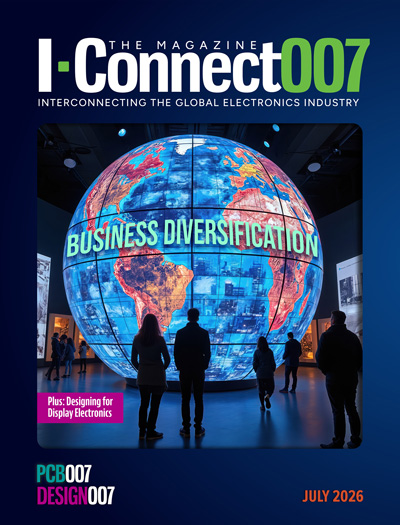



 Elementary, Mr. Watson: The Rise and Fall of Europe's PCB Design Community
 Connect the Dots: What PCB Designers Should Know About Materials
 Designers Notebook: Implementing Strategic Planning Principles for PCB Design






Marcy’s Musings: Old School vs. New School—When Does It Matter?
The battle between old and new is nothing new. Throughout history, technological progress has faced skepticism, resistance, and at times, outright hostility. Yet progress tends to win. In his book, RenAIssance, author and APEX EXPO 2026 keynote Zack Kass illustrates this point beautifully. From hand weaving to sewing machines, from scribes to the printing press, from horse-drawn carriages to automobiles, and now to artificial intelligence, each technological leap has ultimately made our lives more productive and expanded what was possible.
Of course, disruptive change is rarely comfortable. That’s why it’s important to separate genuine innovation from hype. This month, our contributors tackle that question as we explore old-school vs. new-school thinking in PCB and system design.
Several authors argue that new approaches are not simply preferable; they are becoming necessary. In his column, Barry Olney says that as data rates push beyond 112G PAM4 toward 224G PAM4 and beyond, traditional stripline and microstrip geometries are reaching their limits. In some cases, the physics simply no longer cooperate.
Columnist Matt Stevenson challenges traditional supplier-selection methods with the concept of total value management (TVM). Rather than focusing primarily on cost, TVM emphasizes collaboration, innovation, agility, and long-term partnership. The best manufacturing partners, he says, help customers navigate increasingly complex prototyping and production decisions, whether domestic or offshore.
Likewise, new contributor Pentalogix argues that the long-standing practice of “throwing designs over the wall” to fabricators is no longer sustainable. Designers and manufacturers must communicate continuously for meaningful progress to occur.
Kristin Moyer explores another shift in thinking through a discussion of concurrent design vs. co-design. While concurrent design allows multiple disciplines to work in parallel, co-design leverages integrated data environments that enable electrical, mechanical, RF, thermal, and other engineers to collaborate simultaneously. The result can be shorter development cycles, fewer revisions, lower costs, and higher first-pass success rates.
Vern Solberg also lands firmly in the new-school camp by examining advanced packaging technologies and the expanding role PCB designers must play as electronic systems become increasingly integrated.
Not everyone is ready to abandon traditional thinking, however. John Watson opens his column with Jean-Baptiste Alphonse Karr’s famous observation: “The more things change, the more they stay the same.” While PCB design tools and technologies have evolved dramatically since the days of Mylar tape, Watson reminds us that the fundamental principles of good design remain remarkably consistent. Watson also expands on this theme in a June edition of Design007 Week, where he takes a critical look at how to educate designers for the future.
Stephen Chavez examines using digital twin in design. Kelly Dack continues his exploration of signal integrity influencers in the second part of his series on “Signal Integrity Without Borders,” reinforcing that while technologies change, the underlying engineering disciplines remain essential.
On the fabrication side, we explore one of the industry’s newest frontiers: every layer interconnect (ELIC), sometimes called every layer microvia (ELMV). The technology is so new that the industry has yet to settle on a single name.
Anaya Vardya of ASC introduces ELIC technology, explaining its capabilities, density advantages, and manufacturing challenges. Ralph Jacobo of all4-PCB discusses the critical role equipment technology plays in supporting the multiple lamination cycles required for these advanced stackups. Materials expert Ed Kelley rounds out the conversation by examining material selection, high-speed performance, and microvia reliability considerations in staggered and stacked microvia designs.
Our PCB columnists cover a diverse set of topics. Don Ball tackles common etching questions and challenges the long-held assumption that faster is always better. Mike Carano examines insertion loss and signal distortion associated with final surface finishes, including the impact of roughness and nickel thickness on signal performance. Meanwhile, Shane Whiteside provides an update on the Printed Circuit Board and Substrates Act as it advances through Congress.
Additional features include Richard Nichols’ case study on achieving extremely high aspect ratios, Anaya Vardya looking at flex in medical technology and PCBs, and Sean Patterson has a practical roadmap for AI adoption within PCB manufacturing operations.
We also celebrate EPTAC’s new headquarters and long-standing contributions to industry training, and share highlights from my recent visit to Schneider Electric in Buffalo, New York, where I learned more about the AI-driven data center infrastructure reshaping the electronics supply chain.
As you read through this issue, I encourage you to consider which ideas truly represent the future and which enduring principles still deserve a place in our toolbox. After all, progress is rarely about replacing everything that came before. More often, it’s about knowing what to keep, what to improve, and what to leave behind.
This column originally appeared in the June 2026 issue of I-Connect007 Magazine.


