













 Elementary, Mr. Watson: Waking Up Europe's PCB Giants
 Connect the Dots: Getting the PCB Quote Right
 Powering the Future: What Engineers Get Wrong About Designing for Reliability





Flying cars, hoverboards and video chat – a very futuristic vision for the year 2015 was presented in the movie “Back to the Future Part II”, released in 1989. Now, shortly before “Back to the Future Day” on October 21st, 2015, it is time to check whether reality has indeed kept up with the daring predictions of the 80s.
One of the technological innovations presented in this film was a huge 3D display. As far as this invention is concerned, Hollywood was almost right. Such displays will soon be possible. TU Wien and TriLite Technologies are presenting a display element which uses special micro optics and moving micro mirrors to project different pictures into different directions. This technology can be used to create 3D displays without the need for 3D glasses.
3D Pictures on Huge Outdoor Displays
Marty McFly, the protagonist of the movie “Back to the Future Part II”, uses a time machine to travel from the year 1985 to October 21st, 2015. In the technological utopia of 2015 he is in for quite a few surprises. One of them is a colossal display on top of a cinema, from which a terrifying 3D shark seems to jump out to get him. Back in the 80s, no viable concepts for such a 3D display technology existed. But today, this technology is within reach.
A first prototype has been developed by TriLite Technologies and TU Wien a few months ago. Each 3D pixel (called “TrixelTM“) consists of a laser and a moveable mirror. The mirror directs the laser beams across the field of vision, from left to right. During that movement the image information is changed. With this basic idea, different pictures can be sent to the viewer´s left and right eye, so that a 3D effect is created without the need for 3D glasses.
New Prototype, Just in Time for Back to the Future Day
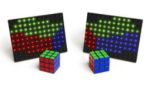
Now, a much more advanced second prototype has been presented. It is now a full color display, a significant advancement over the first monochromatic version. Each Trixel has been equipped with three different lasers (red, green and blue). The module consists of 12x9 Trixels, so any number of modules can be assembled to create a large outdoor display. “The software for controlling the modules and displaying movies has already been developed”, says Jörg Reitterer (from TriLite Technologies, and PhD student in Professor Ulrich Schmid’s team at TU Wien). “We can use any off-the-shelf 3D movie and play it on our display.”
“The basic technology was invented by TriLite Technologies in 2011. At TU Wien, three research institutes worked on different tasks such as steering the Trixels and optimizing the connection between them. The technology is now ready for the market, and we are looking for partners for mass production all over the world”, says Franz Fidler, CTO of TriLite Technologies.


