













 The Marketing Minute: Marketing Is a Team Sport
 The Right Approach: Old Philosophies, New Tools
 Trouble in Your Tank: HDI and UHDI—Building the Foundation of Advanced Packaging





For as high-tech as Department of Homeland Security operations have become (think ground-penetrating radar and predator drones), radio communications for the federal agency remain entrenched in the previous century. Customs and Border Protection agents, for example, alternate between cell phones and handheld radios depending on the availability of broadband commerical networks—a cumbersome approach that may require switching between technologies in the midst of sometimes tense scenarios.
But researchers from the University of California, San Diego Qualcomm Institute, in collaboration with MaXentric Technologies, are hoping a new technology that bridges legacy land-mobile radio (LMR) and LTE cellular networks will provide the upgrade the Department of Homeland Security needs to improve performance, reliability, security and interoperability, for a low price.
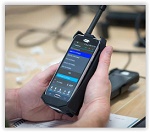
Known as the MaXphone (or officially, Multi-Access Extension for Smartphones), the prototype device consists of a plastic sleeve or “MaXjacket” that fits over potentially any smartphone. The user can use the smartphone just as he or she ordinarily would, or use the MaXphone’s custom-designed app to “convert” the phone into a land-mobile radio. The app does this by controlling the radio hardware inside the MaXjacket and connecting to the LMR standard network known as P25. It does this via voice-over-IP or VOIP, essentially setting up a conference call.
“The hardware developed for the MaXjacket runs an open-source software defined radio (SDR) version of P25,” said Per Johansson, Vice President of Engineering at MaXentric, lead principal investigator on the project and a principal development engineer at the Qualcomm Institute. “The open-source SDR approach gave us a lot of design flexibility and access to all parts of the radio.
Added Johansson: “One of the key aspects of this device that makes it different from any other solution is that it provides the opportunity to develop apps for the LMR radio. There are other potential apps that could utilize the P25 voice services – you could write an app that sends simple GPS data, for example, such as when a firefighter is fighting a fire where there’s no 4G coverage.
“What we’ve done is open up the LMR radio to the same revolution smartphones have undergone,” he continued. “Before your cell phone was a smartphone you could do very few things with that phone. Then came app development, which changed everything. Your smartphone is nothing without the apps. It’s one thing to have a network, but the more important thing is to do something on the network. On the LMR side, as far as I know that’s never happened until now.”
Co-PI Curt Schurgers, a principal development engineer and director of the Wireless Systems Laboratory at the Qualcomm Institute, likens the MaXphone to a bridge that connects two parallel highways.
“Cellular and P25 are access technologies. They’re like on-ramps that allow you to get onto a specific network. Before now, we didn’t have a way to get from one network to the other using the same device,” he said, noting that QI researchers Anthony Nwokafor and Justin Bell were the key software developers on the QI side, shouldering the technical load.
Page 1 of 2


