















 Connect the Dots: Designing for the Future of Manufacturing Reality—Solder Mask and Legend
 Target Condition: An Exploration of Flooding PCB Layers
 Happy’s Tech Talk #47: Automation for Complex Multilayer Fabrication Stackups





DownStream Technologies Update With Joe Clark
June 17, 2020 | Andy Shaughnessy, Design007 MagazineEstimated reading time: 7 minutes
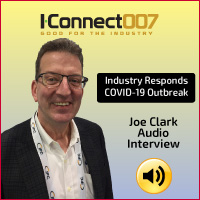
On June 15, Andy Shaughnessy spoke with Joe Clark, co-founder of DownStream Technologies, about the company’s drive to take care of its customers and employees throughout the pandemic and beyond.
As the U.S. slowly starts reopening, Joe discusses some of his customers’ current challenges, especially those working from home for the first time, and how DownStream’s forecast has helped the company prepare for the uncertainties in the industry right now. He also explains the company’s focus on presenting educational webinars, and why he believes that webinars will continue to be a major format for training, though nothing will ever replace face-to-face classes at conferences and trade shows.
Related Links:
- To download the audio (mp3) file for this interview, click here.
Audio Transcript:
Andy Shaughnessy: Hi, Andy Shaughnessy here for Design007. Today, I’m speaking with Joe Clark, co-founder of DownStream Technologies. Welcome, Joe.
Joe Clark: Thanks for the opportunity, Andy. It’s good to talk to somebody.
Shaughnessy: You stayed up and running during the pandemic. Why don’t you give us a quick update on DownStream?
Clark: Sure. We have indeed, like many companies, continued with business. Our business plan, Andy, was done like most companies in the November/December timeframe, and it was based on a very good 2019. We weren’t crazy optimistic, but we looked for some modest growth over what we did in 2019. That was before any of us could spell “corona.” Well, maybe we could spell the beer, but not the virus. Getting into January and then February, we started hearing more about this. Companies were starting to send their employees home to work for home and so on. Today, we’ve met the plan that we laid out before any of this started. Our business success to date has been very good. We’re on plan. My own belief is that the second half of the year will be more difficult.
We don’t have any misgivings that we’re going to have a flat or a slightly down year, given the circumstances. We are planning for the second half of the year to be more challenging for us, especially Q4. I don’t have a crystal ball, but given what’s occurred, it’s reasonable to expect some softness. But we’re pleasantly surprised and happy with the results so far, which have been to plan.
Shaughnessy: There have been some silver linings, definitely.
Clark: Absolutely. And we, like many companies, are all working from home. We’ve successfully transitioned that. We initiated that activity before it was mandated in Massachusetts so that we were set up in time rather than having it be mandated and then panicking and trying to get out and put it in place. We were all prepared and working from home fully. We’ve opened the office back up, but it’s only partially open.
Shaughnessy: What trends do you see in the industry right now?
Clark: I guess there are two. The standard typical productivity technology trends that we all deal with on an annual basis, and then coronavirus pandemic trends. On the productivity and technology level, companies are still having to deal with new technologies, and how do we bring them in-house and keep the same level of productivity while we bring in new technologies? I talked with you at IPC APEX EXPO about this as well, and we’re heavily invested in developing new releases to support this, but the major issues our customers are dealing with are flex and embedded components—not only in their documentation, but in their space of design for manufacturing, or find that these designs can be manufactured correctly and in volume.
That’s ongoing, and as a result of the coronavirus, we see a slowdown in that area in the sense that many companies with the coronavirus focused on our employees now have to work from home. It’s not some of us trading days working from home; everybody’s working from home. Their immediate impact for many companies was setting up all the tools, resources, etc., for everybody to be working from home. And there was some difficulty with that. We’ve worked with many of our customers. For example, we would set up extra licenses on home computers to help them so that they could be productive. We added licenses to their service because there are now more people checking them out, and they aren’t communicating with each other because they’re all home. We also expanded wide-area networking (WAN) access.
In other words, we partnered with our customers to help them get themselves set up. And we weren’t the only ones doing that. They had their hands full, again, setting everybody up at home. That’s certainly most of the first quarter and into the second quarter. With everybody working from home as well, you see less focus on productivity improvements, new tools, and new ideas because we’re going to kind of put that to bed right now. We’re going to focus on just surviving as we are right now until we can go back to the office. There are two trends there. Again, there are the ongoing technology trends that companies are dealing with, as well as the results of this coronavirus, and that has been the primary focus of most companies.
Shaughnessy: And one thing I’ve noticed during this whole thing is that DownStream has been producing a lot of webinars. Do you see that as being a major format for designer training as we move past the pandemic?
Clark: Yes, yes, and yes. We’ve all talked about this where we rely too much on the internet for information and decision making and so on—less face time, which I don’t think is a good thing. Trade shows, user groups, and different forums where people can come together and see your new idea have suffered in the past. But with companies, as we just talked about, now being forced for everybody to work from home, they’ve actually been very successful at this. In fact, in our webinars, this has been an interesting development. We have many of our existing customers—not only new customers—which is the primary focus. It’s about new opportunities and getting your idea out there, but we’ve had existing customers come in large numbers. It’s almost like they are saying, “I have time on my hand. I want to learn more about what all the capabilities are that I may not be aware of in these DownStream tools.”
As a result of that, we’ve driven new sales because the capacity requirements go up—separate from just being at home and the license sharing and so on that we did to partner with our customers. This tool will pass this current pandemic, and we’ll get back to some sense of normalcy. The success companies have seen virtually will be with us forever, and I’ll give you an analog to that. My wife is a doctor, and for a pretty significant period of time, she had to shut her office, as many doctors and dentists did. But what has grown out of this current situation as a doctor is virtual medicine. It really wasn’t something that was being practiced very much—certainly not in this country. And it is now a very hot topic, and the doctors are now very interested in this capability. It has a long way to go, but it’s an analog to what I was talking about here.
It’s going to be with us, and it’s going to grow as part of our business. It’s all as good as the apps that they have, and these companies are developing this technology—the internet and bandwidth we have; it’s all a reality, and we’ve been forced into doing it. And it has worked pretty well. This virtual world that we’re living in is going to be with us after as well. And for companies like us, we will work to take advantage of it. Though I’m an old-timer and still think face time and the trade shows and those venues are still very important.
Shaughnessy: Joe, is there anything else you’d like to add, or we haven’t covered?
Clark: No, that’s pretty much it. Talking about the virtualization, one of the things that we haven’t heard yet, several companies—which is eye-opening to me, and this has worked so well for them—are talking about a permanent work from home where there are gains from that. There’s no travel time, trust reduction, low costs of facilities, and so on. We might even see companies that, for the most part, where there may be periodic days where you have to come in the office, but a large part of the workforce will be working remotely permanently. It will be interesting.
Shaughnessy: It’s definitely interesting.
Clark: Interesting times. And we have a ways to go in this year. I’m always optimistic, but we’ll see what comes in the second half.
Shaughnessy: All right. Joe, thanks for speaking with me. It’s always a pleasure.
Clark: Thanks, Andy. Same here.
Shaughnessy: Again, I’ve been speaking with Joe Clark of DownStream Technologies. I’m Andy Shaughnessy for Design007. Thanks for listening.
Share on:


Testimonial
"Our marketing partnership with I-Connect007 is already delivering. Just a day after our press release went live, we received a direct inquiry about our updated products!"
Rachael Temple - AlltematedSuggested Items
SMTA Announces 2026 STAR Forum Technical Program
04/16/2026 | SMTAThe SMTA announced the finalized program for the High Reliability: Strategic Technology Advancement Research Forum which takes place on May 6-7, 2026 in Olathe, Kansas, USA.
From AI to AEP, an Impressive Array of Keynotes at APEX EXPO 2026
04/17/2026 | Marcy LaRont and Nolan Johnson, I-Connect007Each year at APEX EXPO, the Global Electronics Association provides an impressive lineup of keynote speakers to kick off the largest electronics manufacturing event in North America. This year included four keynote speeches, on topics ranging from the promise and peril of AI to the power of electronics, quantum computing, and the importance of heterogeneous integration in advanced electronics packaging.
Breaking the Manual Quoting Bottleneck in Wire Harness
04/15/2026 | Nolan Johnson, SMT007 MagazineArik Vrobel has spent more than 35 years in wire harness manufacturing—starting in EL-Com, his father's shop, building it into a nationally recognized contract manufacturer, and ultimately selling to Aptiv/Winchester in 2021. But retirement didn't last long. Within months, Arik was back, not as a manufacturer this time, but as a technologist. His new company, Cableteque, is building the quoting and data automation platform he always wished existed.
Podcast Hits the Mark in a Materials Market
04/15/2026 | Marcy LaRont, I-Connect007The base material of a printed circuit board is its literal and functional foundation. Isola, founded in 1912 in Düren, Germany, is one of the longest-standing manufacturers of glass-reinforced laminates in the electronics industry. Originally focused on insulation and fiberglass materials, the company played an early role in supplying the foundational substrates that enabled the growth of PCB technology. As electronics advanced, Isola evolved alongside the industry, expanding from basic glass-epoxy laminates into high-performance copper-clad materials and engineered prepregs.
New EIPC President: Building Strength Through Unity in Europe’s Electronics Industry
04/14/2026 | Marcy LaRont, I-Connect007Industry veteran Rico Schluter, newly appointed president of EIPC, discusses his decades-long journey through the European PCB industry and his vision for its future. From building advanced manufacturing operations to leading large-scale facility development in Lithuania, Rico shares insights into automation, workforce evolution, and the challenges of scaling production. He emphasizes the urgent need for stronger collaboration across European industry organizations to effectively influence policy in Brussels, particularly around supply chain resilience, trade regulations, and energy-related incentives.