














 Dan’s Biz Bookshelf: ‘Building a Story Brand 2.0’
 It’s Only Common Sense: Why Should They Take Your Call?





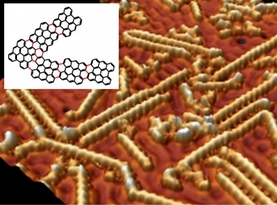
An international research team at Tohoku University's Advanced Institute of Materials Research (AIMR) succeeded in chemically interconnecting chiral-edge graphene nanoribbons (GNRs) with zigzag-edge features by molecular assembly, and demonstrated electronic connection between GNRs. The GNRs were interconnected exclusively end to end, forming elbow structures, identified as interconnection points (Fig. 1a).
This configuration enabled researchers to demonstrate that the electronic architecture at the interconnection points between two GNRs (Fig. 1b) is the same as that along single GNRs; evidence that GNR electronic properties, such as electron and thermal conductivities, are directly extended through the elbow structures upon chemical GNR interconnection.
This work shows that future development of high-performance, low-power-consumption electronics based on GNRs is possible.
Fig. 1. (a) Interconnected graphene nanoribbons (GNRs). The interconnection points are observed as elbow structures. The inset of (a) shows the chemical structure of an elbow interconnection point of two chiral-edge GNRs. The top panel of (b) shows the scanning tunneling microscopy topograph, highlighting a single GNR and a pair of connected GNRs (elbow). The bottom panel of (b) shows the local density of states (LDOS) of these two structures share the same electronic architecture, including the elbow interconnection point. This indicates that electronic properties, such as electron and thermal conductivities, should be comparable between termini 1-2 and termini 3-4.
Graphene has long been expected to revolutionize electronics, provided that it can be cut into atomically precise shapes that are connected to desired electrodes. However, while current bottom-up fabrication methods can control graphene's electronic properties, such as high electron mobility, tailored band gaps and s pin-aligned zigzag edges, the connection aspect of graphene structures has never been directly explored. For example, whether electrons traveling across the interconnection points of two GNRs would encounter higher electric resistance remains an open question. As the answers to this type of questions are crucial towards the realization of future high-speed, low-power-consumption electronics, we use molecular assembly to address this issue here.
"Current molecular assemblies either produce straight GNRs (i.e., without identifiable interconnection points), or randomly interconnected GNRs," says Dr. Patrick Han, the project leader. "These growth modes have too many intrinsic unknowns for determining whether electrons travel across graphene interconnection points smoothly. The key is to design a molecular assembly that produces GNRs that are systematically interconnected with clearly distinguishable interconnection points."
Page 1 of 2


